Wind Speed Unit of Measurement
Learn how wind speed is measured and which units are commonly used. Compare miles per hour, knots, kilometers per hour, meters per second, and the Beaufort scale with simple conversion formulas and reference tables.
What is the unit of measurement for wind speed?
There is no single universal unit for wind speed. Different industries and countries use different units depending on their conventions.
The SI unit for speed is meters per second, so m/s is the standard metric unit used in scientific and engineering applications.
Other widely used units include mph, knots, and km/h.
What are the most common wind speed units?
| Unit | Full Name | Common Use |
|---|---|---|
| mph | Miles per hour | Weather reports in the United States and some other countries. |
| kn / kt | Knots | Marine navigation and aviation. |
| km/h | Kilometers per hour | Weather reports and everyday use in many countries. |
| m/s | Meters per second | Scientific, engineering, and meteorological applications. |
| Beaufort | Beaufort wind force scale | Describing wind force and observed sea or land conditions. |
What is wind speed measured in for marine navigation?
Wind speed is commonly measured in knots in marine navigation and maritime weather reports.
One knot is exactly one nautical mile per hour.
$$1\ knot = 1\ nautical\ mile/hour$$
Because nautical miles are used for marine distances, knots provide a convenient speed unit for sailors and boaters.
What is a knot in wind speed?
A knot is a unit of speed equal to one nautical mile per hour.
One international nautical mile is exactly 1,852 meters, so:
$$1\ knot = 1.852\ km/h$$
$$1\ knot \approx 0.5144\ m/s$$
$$1\ knot \approx 1.1508\ mph$$
What is wind speed measured in for weather?
Weather services use different units depending on the country or organization. Common choices include mph, km/h, knots, and m/s.
Wind speed in marine forecasts is often given in knots, while weather information for land areas may use mph or km/h.
What is the SI unit for wind speed?
The SI unit for wind speed is meters per second (m/s).
Meters per second are widely used in scientific and engineering calculations because they work directly with SI units such as meters, kilograms, newtons, and pascals.
How do you convert wind speed from knots to mph?
Multiply knots by approximately 1.15078:
$$mph = knots \times 1.15078$$
For example, 20 knots is approximately:
$$20 \times 1.15078 \approx 23.02\ mph$$
How do you convert mph to knots?
Divide miles per hour by approximately 1.15078:
$$knots = \frac{mph}{1.15078}$$
For example, 30 mph is approximately 26.07 knots.
How do you convert wind speed from knots to km/h?
Multiply knots by 1.852:
$$km/h = knots \times 1.852$$
For example:
$$20\ knots = 37.04\ km/h$$
How do you convert wind speed from km/h to knots?
Divide kilometers per hour by 1.852:
$$knots = \frac{km/h}{1.852}$$
How do you convert wind speed from m/s to knots?
Divide meters per second by approximately 0.51444:
$$knots = \frac{m/s}{0.51444}$$
Alternatively:
$$1\ m/s \approx 1.94384\ knots$$
How do you convert wind speed from mph to m/s?
Multiply mph by 0.44704:
$$m/s = mph \times 0.44704$$
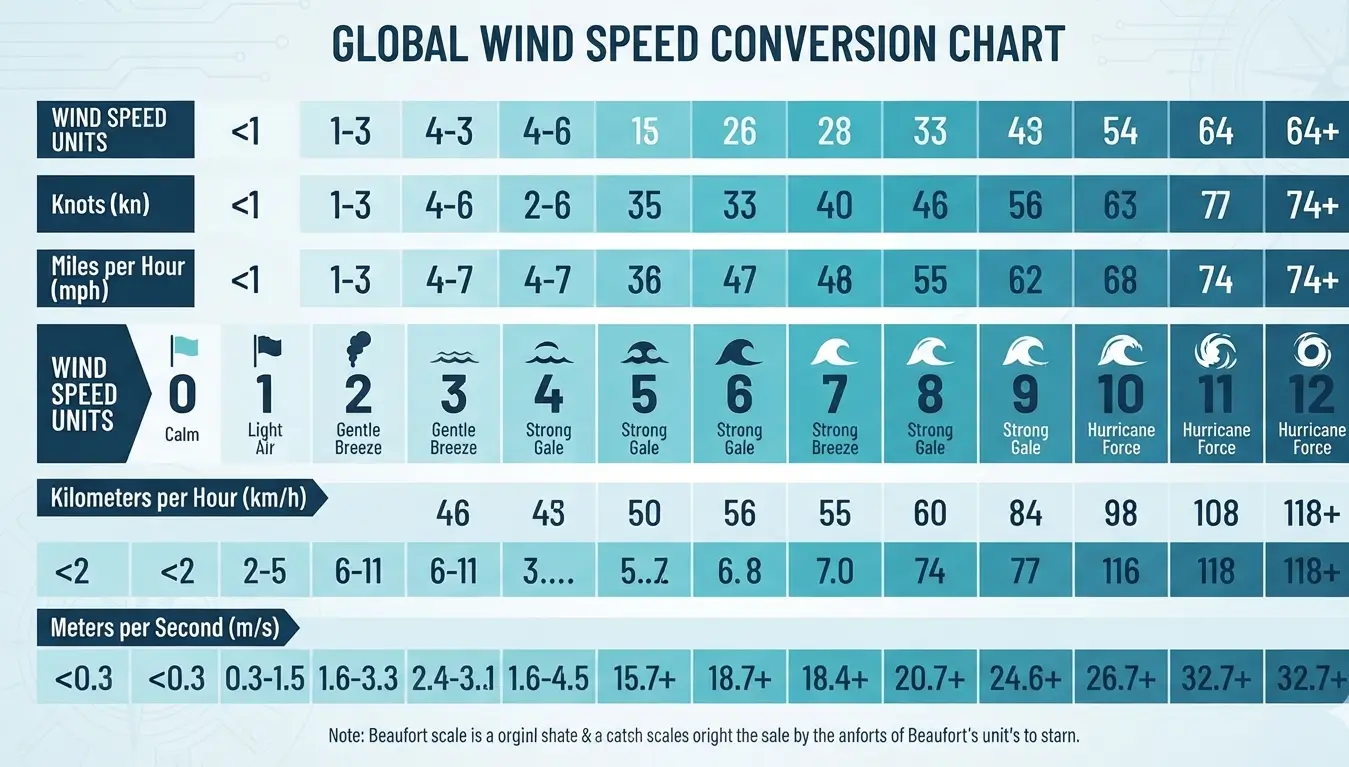
Wind Speed Conversion Chart
Use this chart to compare the most common wind speed units.
| mph | knots | km/h | m/s |
|---|---|---|---|
| 5 | 4.34 | 8.05 | 2.24 |
| 10 | 8.69 | 16.09 | 4.47 |
| 15 | 13.03 | 24.14 | 6.71 |
| 20 | 17.38 | 32.19 | 8.94 |
| 25 | 21.72 | 40.23 | 11.18 |
| 30 | 26.07 | 48.28 | 13.41 |
| 35 | 30.41 | 56.33 | 15.65 |
| 40 | 34.75 | 64.37 | 17.88 |
| 50 | 43.48 | 80.47 | 22.35 |
| 60 | 52.15 | 96.56 | 26.82 |
| 70 | 60.85 | 112.65 | 31.29 |
| 80 | 69.51 | 128.75 | 35.76 |
| 90 | 78.21 | 144.84 | 40.23 |
| 100 | 86.98 | 160.93 | 44.70 |
What is the Beaufort scale?
The Beaufort scale is a descriptive scale used to classify wind force by ranges of wind speed and the effects of wind on the sea or land. Unlike mph, knots, and m/s, it does not represent a conventional linear physical unit of speed.
The scale ranges from Beaufort Force 0, calm, through Beaufort Force 12, hurricane-force winds in the traditional scale.
Is Beaufort a unit of wind speed?
Strictly speaking, Beaufort is a wind-force scale rather than a physical unit such as knots or meters per second.
Each Beaufort number corresponds to a range of wind speeds and historically also to observable conditions.
Wind Speed and Beaufort Scale Chart
| Beaufort | Description | Approx. Wind Speed (knots) | Approx. Wind Speed (m/s) |
|---|---|---|---|
| 0 | Calm | Less than 1 | 0–0.2 |
| 1 | Light air | 1–3 | 0.3–1.5 |
| 2 | Light breeze | 4–6 | 1.6–3.3 |
| 3 | Gentle breeze | 7–10 | 3.4–5.4 |
| 4 | Moderate breeze | 11–16 | 5.5–7.9 |
| 5 | Fresh breeze | 17–21 | 8.0–10.7 |
| 6 | Strong breeze | 22–27 | 10.8–13.8 |
| 7 | Near gale | 28–33 | 13.9–17.1 |
| 8 | Gale | 34–40 | 17.2–20.7 |
| 9 | Strong gale | 41–47 | 20.8–24.4 |
| 10 | Storm | 48–55 | 24.5–28.4 |
| 11 | Violent storm | 56–63 | 28.5–32.6 |
| 12 | Hurricane force | 64+ | 32.7+ |
What unit is used for wind speed on boats?
Knots are the standard practical unit used for marine navigation, sailing, boating forecasts, and many marine weather services.
This is especially convenient because nautical distance is also measured in nautical miles.
Why do sailors use knots instead of mph?
Knots are directly linked to nautical miles. A speed of 10 knots means the vessel or wind is moving at 10 nautical miles per hour.
This makes knots particularly convenient for navigation and marine weather calculations.
What wind speed unit is used in aviation?
Knots are also widely used in aviation for airspeed and wind speed. This provides a shared speed convention between marine navigation and aviation.
What wind speed unit is used in engineering?
Engineering calculations commonly use meters per second because m/s is an SI unit. Wind pressure and aerodynamic calculations can then be combined directly with SI quantities such as air density in kg/m³ and pressure in pascals.
$$q = \frac{1}{2}\rho V^2$$
V is commonly expressed in m/s in SI calculations.
Why are wind speed units different between countries?
Different countries and industries developed around different measurement systems and conventions. The United States commonly uses mph for everyday weather, many countries use km/h, scientific applications often use m/s, and maritime applications commonly use knots.
What is the best wind speed unit to use?
The best unit depends on the application:
- Knots: boating, sailing, marine weather, and aviation.
- mph: everyday weather information in the United States.
- km/h: everyday weather information in many metric countries.
- m/s: science, meteorology, and engineering calculations.
- Beaufort: describing wind force and observed conditions.
What is 10 knots in mph?
$$10\ knots \approx 11.51\ mph$$
What is 20 knots in mph?
$$20\ knots \approx 23.02\ mph$$
What is 30 knots in mph?
$$30\ knots \approx 34.52\ mph$$
What is 20 mph in knots?
$$20\ mph \approx 17.38\ knots$$
What is 100 km/h in knots?
$$100\ km/h \approx 53.996\ knots$$
What is 10 m/s in knots?
$$10\ m/s \approx 19.44\ knots$$
Wind speed unit FAQ
The SI unit is meters per second (m/s). Knots, mph, and km/h are also commonly used depending on the application.
Knots are the standard practical unit used by sailors and in marine weather reports.
Yes. A knot is a unit of speed equal to one nautical mile per hour.
Beaufort is a wind-force scale rather than a conventional physical unit like knots, mph, or m/s.
NOAA products use different units depending on the product and audience. Marine forecasts commonly use knots, while other weather products can provide wind speed in mph or other units.
Knots are generally the most convenient unit for boaters because nautical miles and knots are the standard marine distance and speed conventions.