What Wind Speed Is Dangerous for Sailing?
Learn when wind becomes dangerous for sailing and why there is no single wind-speed limit that applies to every sailboat. Compare wind speed in knots, mph, and Beaufort force, understand how waves and gusts increase risk, and learn when conditions may be inappropriate for small boats, cruising sailboats, and inexperienced crews.
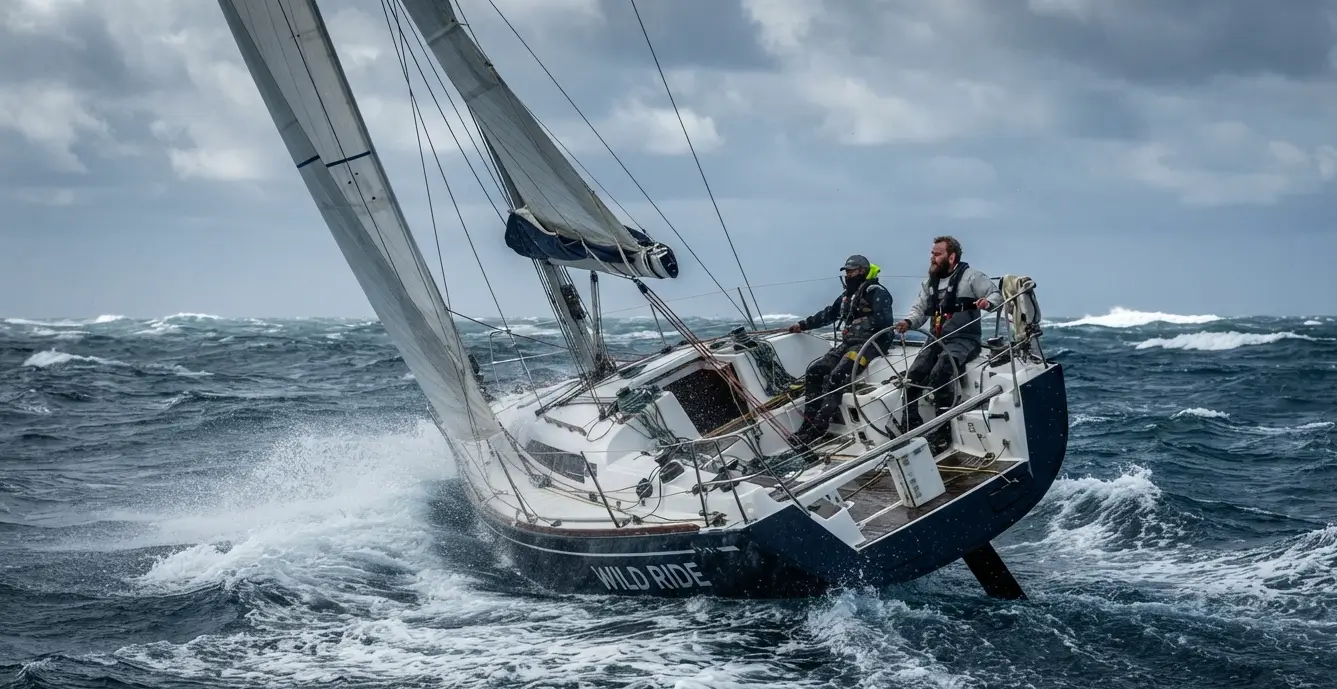
What wind speed is dangerous for sailing?
A practical answer depends heavily on the boat and crew. A wind speed that is manageable for a large, well-prepared cruising yacht may be unsafe for a small dinghy or lightly crewed sailboat.
As wind increases, the sea state normally increases as well. The Beaufort scale classifies 22–27 knots as a strong breeze, 28–33 knots as near gale, and 34–40 knots as gale force. The Met Office associates these ranges with increasingly rough and high sea states. :contentReference[oaicite:1]{index=1}
What wind speed is too strong for a small sailboat?
Small sailboats can become difficult to control well before gale-force winds. Around 20 knots and above, conditions can become demanding for many small boats, particularly when the wind is gusty and the water is open or exposed.
At 22–27 knots, the Beaufort scale describes the wind as a strong breeze and the sea as rough. At 28–33 knots, the wind reaches near-gale strength and the sea becomes rough to very rough. :contentReference[oaicite:2]{index=2}
Is 20 knots too much wind for sailing?
Not necessarily. Twenty knots is within the range that experienced sailors may handle routinely in a suitable boat, but it is also strong enough to require active sail management and appropriate preparation.
At 20 knots, the wind falls within Beaufort Force 5, whose range is 17–21 knots. The sea is described as moderate, with whitecaps and increasingly pronounced waves. :contentReference[oaicite:3]{index=3}
For a beginner, a smaller boat, or a confined area with limited maneuvering room, 20 knots can be considerably more challenging than the number alone suggests.
Is 25 knots too much wind for sailing?
Twenty-five knots is a strong-breeze condition under the Beaufort scale and falls within Force 6. The Met Office lists 22–27 knots for Force 6 and describes the sea as rough, with probable significant wave heights around 3 m in well-developed open-sea conditions. :contentReference[oaicite:4]{index=4}
That does not automatically mean every sailboat must remain in port, but it is a serious condition for many recreational sailors. Boat handling, reefing experience, crew preparation, and the availability of shelter become increasingly important.
Is 30 knots dangerous for sailing?
Thirty knots falls within Beaufort Force 7, classified as near gale. This range is associated with rough to very rough seas and significantly more challenging handling conditions. :contentReference[oaicite:5]{index=5}
For many recreational boats, 30 knots should be treated as a serious heavy-weather condition rather than ordinary cruising weather. Experience, boat design, sail plan, reefing system, and distance from shelter all become critical.
Is 40 knots too much wind for sailing?
Forty knots is at the upper end of Beaufort Force 8, gale force. The Beaufort scale places 34–40 knots in Force 8 and associates it with very rough to high seas. :contentReference[oaicite:6]{index=6}
For ordinary recreational sailing, 40 knots should be treated as severe weather. A sailor caught in those conditions needs a vessel, crew, equipment, and heavy-weather plan appropriate for the situation.
What wind speed is considered gale force?
Gale-force wind begins at 34 knots on the Beaufort scale. Force 8 covers 34–40 knots, Force 9 covers 41–47 knots, and higher Beaufort forces represent storm and hurricane conditions. :contentReference[oaicite:7]{index=7}
$$34\ knots \approx 39.1\ mph$$
$$40\ knots \approx 46.0\ mph$$
What wind speed is considered storm force at sea?
Beaufort Force 10 begins at 48 knots and extends to 55 knots. Force 11 covers 56–63 knots, while Force 12 begins at 64 knots. These ranges correspond to storm, violent storm, and hurricane descriptions on the Beaufort scale. :contentReference[oaicite:8]{index=8}
Wind speed danger chart for sailing
This table is intended as a practical reference, not a universal go/no-go rule. The Beaufort classifications and sea descriptions come from established marine weather scales. :contentReference[oaicite:9]{index=9}
| Wind Speed | Beaufort | Wind Description | Typical Sailing Concern |
|---|---|---|---|
| 0–10 kn | 0–3 | Calm to gentle breeze | Usually manageable; light-air performance can become the main issue. |
| 11–16 kn | 4 | Moderate breeze | Normal sailing conditions for many boats; whitecaps become common. |
| 17–21 kn | 5 | Fresh breeze | More active sail trim and increasing heel; conditions can challenge beginners. |
| 22–27 kn | 6 | Strong breeze | Rough sea state; reefing and crew preparation become increasingly important. |
| 28–33 kn | 7 | Near gale | Serious heavy-weather conditions for many recreational sailboats. |
| 34–40 kn | 8 | Gale | Severe conditions; many recreational sailors should avoid exposure. |
| 41–47 kn | 9 | Strong gale | Very severe conditions requiring appropriate heavy-weather capability. |
| 48–55 kn | 10 | Storm | Extreme conditions for recreational sailing. |
| 56–63 kn | 11 | Violent storm | Extremely dangerous conditions. |
| 64+ kn | 12 | Hurricane force | Hurricane-force conditions; extremely dangerous at sea. |
What wind speed is safe for beginner sailing?
Beginners generally benefit from relatively gentle and steady wind. A moderate breeze can provide enough power to learn sail trim and steering without introducing the handling demands of strong wind.
There is no universal beginner limit because dinghies, keelboats, catamarans, and cruising yachts respond very differently to wind. Local instructors and the specific boat's operating guidance should take priority.
What wind speed is good for experienced sailing?
Experienced sailors may enjoy a broad range of conditions, but the appropriate wind depends on the boat and intended activity. Many sailors consider moderate to fresh breezes suitable for active sailing, while stronger winds require progressively more preparation.
The important point is that "experienced" does not eliminate weather risk. A capable sailor can still encounter dangerous waves, gusts, equipment failures, or rapidly worsening conditions.
Does wind gust speed matter more than average wind speed?
Gusts can matter greatly. A forecast of 20 knots with frequent 30-knot gusts is a different sailing environment from a steady 20-knot wind.
Rapid changes can make sail handling, steering, and maintaining an acceptable heel angle more difficult.
$$Wind\ Risk \neq Sustained\ Wind\ Speed\ Alone$$
$$Risk = Wind + Gusts + Waves + Current + Boat + Crew$$
Are gusts dangerous for sailing?
Yes. Strong gusts can temporarily produce much more aerodynamic force than the average wind speed suggests. They can increase heel, weather helm, rounding-up, sail loading, and crew workload.
This is especially important on smaller boats where the change in force can have a large effect on stability and control.
How do waves make high wind more dangerous?
Wind and wave conditions interact. As wind increases over sufficient fetch and duration, the sea can become rougher and waves can grow. The Beaufort scale itself associates increasing wind forces with increasingly severe sea states. :contentReference[oaicite:10]{index=10}
A strong wind over a short fetch may produce different conditions from the same wind over a large open-water area. Current opposing the wind can also steepen waves.
Is 15 knots dangerous for sailing?
Fifteen knots is generally within moderate-breeze conditions, corresponding to Beaufort Force 4. The Met Office describes this range as a moderate breeze with slight to moderate sea conditions. :contentReference[oaicite:11]{index=11}
For many sailboats this is manageable weather, although a beginner in a small boat can still find it challenging.
Is 18 knots dangerous for sailing?
Eighteen knots falls within Beaufort Force 5, a fresh breeze. The sea is typically more developed, with frequent whitecaps and increasing spray. :contentReference[oaicite:12]{index=12}
It is not automatically dangerous, but it is noticeably more demanding than light or moderate wind and can be a useful point at which inexperienced sailors should become more conservative.
Is 22 knots dangerous for sailing?
Twenty-two knots marks the beginning of Beaufort Force 6, classified as a strong breeze. The associated sea state is rough and wave heights can become substantial on exposed water. :contentReference[oaicite:13]{index=13}
Many recreational sailors should treat 22 knots as a meaningful escalation in difficulty, particularly when combined with gusts, waves, cold water, or an inexperienced crew.
What wind speed should a sailboat reef?
There is no single reefing wind speed that applies to every boat. Sailors reef according to boat design, sail plan, apparent wind, gusts, sea state, course, and how heavily loaded the rig feels.
A useful principle is to reef before the boat becomes difficult to control rather than waiting until conditions become extreme. Heavy weather guidance commonly emphasizes early sail reduction and having the crew prepared before the worst conditions arrive.
When should you stop sailing because of wind?
Consider ending or shortening the trip when wind, gusts, waves, or visibility exceed the crew's ability or the boat's comfortable operating capability.
- Check the sustained wind and forecast gusts.
- Check the expected wave height, period, and direction.
- Consider wind direction relative to your route and harbor.
- Consider the boat's size, stability, rig, and reefing system.
- Evaluate crew experience and fatigue.
- Check water temperature and consequences of falling overboard.
- Identify safe nearby shelter before conditions deteriorate.
- Turn back early if conditions are becoming harder to manage.
Does boat size determine what wind speed is dangerous?
Boat size is one of the most important factors, but it is not the only one. A large displacement cruising sailboat can have very different behavior from a small dinghy, catamaran, or racing boat.
Hull form, ballast, stability, freeboard, rig design, sail area, reefing systems, cockpit design, and watertight integrity all affect the boat's response to heavy weather.
Does the direction of the wind matter?
Yes. Wind direction relative to the shoreline and your route can change the available fetch, wave development, and maneuvering options.
An offshore wind, onshore wind, crosswind, and headwind can create very different risks even at the same measured wind speed.
Why can 25 knots be safe one day and dangerous another?
Because the wind number is only one part of the environment. Wave height and steepness, current, gustiness, temperature, visibility, distance from shore, traffic, crew condition, and the boat itself can all change the level of risk.
A steady 25-knot wind over sheltered water can be very different from 25 knots against a strong current in open water.
What is the most dangerous combination of wind conditions?
There is no single combination that always produces the highest risk, but several factors can compound each other:
- Strong sustained wind
- Large or steep waves
- Frequent strong gusts
- Wind opposing a strong current
- Limited visibility
- Cold water
- Long distance from shelter
- Inexperienced or fatigued crew
- Boat or rig not prepared for heavy weather
Can a sailboat capsize in strong wind?
Yes. Capsize risk depends on the boat's stability characteristics, sail loading, wave action, crew weight distribution, and the severity and direction of the wind and sea.
Strong gusts and breaking waves can produce loads and angles that are substantially different from what a simple average-wind calculation suggests.
What Beaufort force is dangerous for sailing?
There is no Beaufort number that universally means "unsafe for every boat." However, Force 6 (22–27 knots) represents a strong breeze and rough seas, Force 7 (28–33 knots) is near gale, and Force 8 (34–40 knots) is gale force. Those are progressively more demanding conditions for recreational sailing. :contentReference[oaicite:14]{index=14}
Wind speed and sailing safety FAQ
There is no universal limit. For many recreational sailors, 22–27 knots is already a strong and rough condition, 28–33 knots is near-gale, and 34+ knots is gale force. Boat type and crew experience can move the practical limit substantially.
Not necessarily. Twenty knots is a fresh breeze and can be manageable for an appropriate boat and experienced crew, but it can be challenging for beginners and small boats.
It can be. Twenty-five knots is Beaufort Force 6, a strong breeze with rough seas. Many recreational sailors should treat it as demanding weather rather than ordinary conditions.
Thirty knots is near-gale wind and is serious weather for many recreational boats, particularly small vessels or crews without strong heavy-weather experience.
Forty knots is gale-force wind. For ordinary recreational sailing, this should be treated as severe weather requiring an appropriate heavy-weather-capable boat and experienced crew.
There is no universal cutoff, but beginners should generally avoid conditions that exceed their boat's training environment. Strong breeze and rough-sea conditions can become difficult very quickly.
Strong gusts can create sudden changes in sail force and heel, making conditions significantly harder to control than a steady wind at the same average speed.
Gale force begins at 34 knots and continues through 47 knots across Beaufort Forces 8 and 9.