How to Measure for a Boat Cover
Learn how to measure your boat for a boat cover before ordering a replacement or custom cover. This guide explains overall length, maximum beam, windshield height, bow and stern dimensions, and the equipment that can affect cover fit.
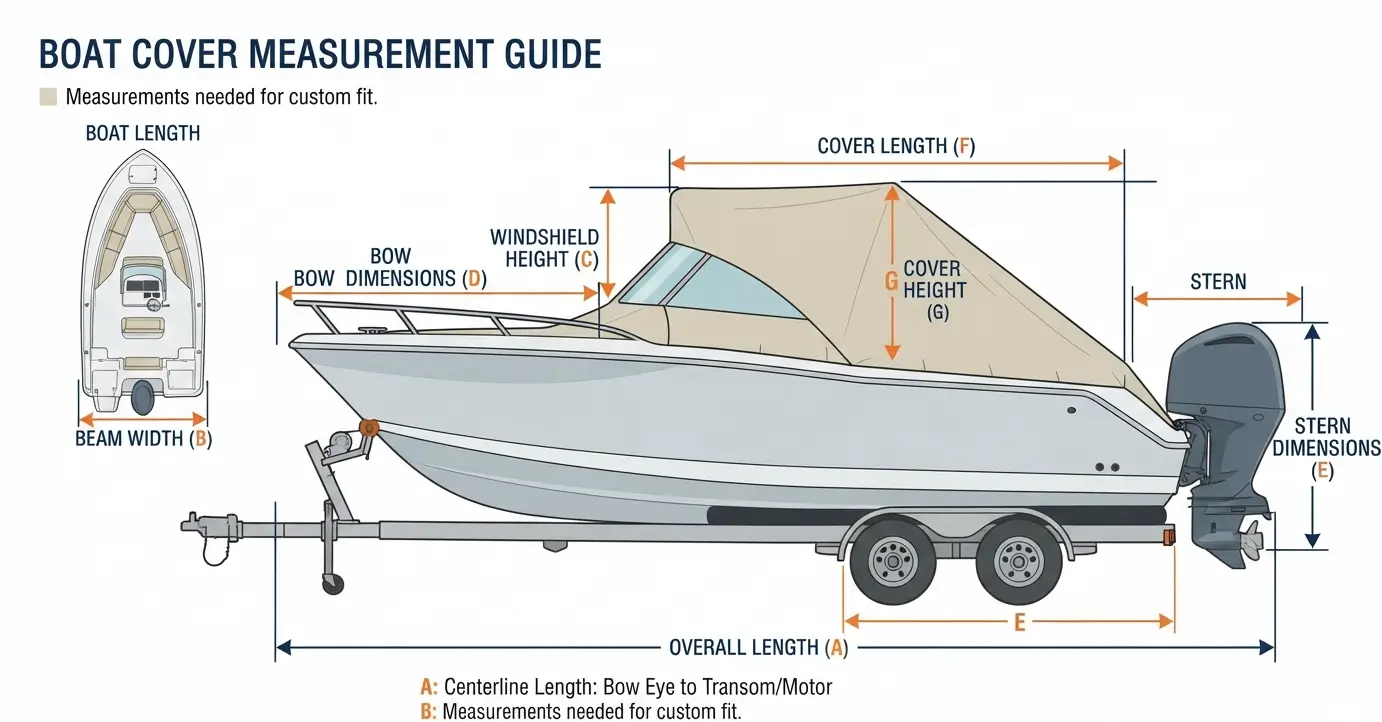
What measurements do you need for a boat cover?
The basic measurements for most boat covers are:
- Overall boat length
- Maximum beam
- Windshield or console height
- Bow shape and length
- Stern shape and configuration
- Rail or gunwale height
- Location of consoles and seats
- Location of towers, arches, or other equipment
The exact measurements needed depend on whether you are buying a universal trailerable cover, semi-custom cover, or a fully custom fitted cover.
How do you measure boat length for a cover?
Measure the hull from the foremost point to the rearmost point according to the cover manufacturer's measurement convention.
Be careful about removable swim platforms, outboards, trolling motors, and other equipment. These may or may not be included in the manufacturer's published boat-length specification.
Boat Length: front of hull → rear of hull
Always compare your measurement with the cover manufacturer's size chart because different manufacturers can define cover length slightly differently.
How do you measure boat beam for a cover?
Beam is the maximum width of the boat. For most boat-cover applications, measure the widest outside-to-outside dimension of the boat.
Maximum Beam: widest outside hull width
Do not use the width of the cockpit or deck unless the cover manufacturer specifically requests that dimension.
Is boat beam the same as cover width?
Not necessarily. A cover must account for the boat's shape, gunwale position, windshield, and the way the fabric is designed to fit over the hull.
Therefore, use the manufacturer's recommended sizing method rather than trying to calculate a cover width from beam alone.
How do you measure boat windshield height for a cover?
Measure from the surface where the cover will sit or where the manufacturer's measurement convention starts to the highest point of the windshield or console structure.
This measurement becomes particularly important when choosing a cover that must fit over the windshield rather than over an open cockpit.
Windshield Height: cover seating surface → highest windshield point
How do you measure a boat for a custom cover?
- Measure the overall hull length.
- Measure maximum beam.
- Measure windshield and console height.
- Measure gunwale or rail height.
- Record bow and stern shapes.
- Record the location of consoles and fixed seats.
- Measure or document towers, arches, rails, and fishing equipment.
- Record swim platforms and other rear extensions.
- Provide photographs or a template when requested by the cover maker.
How do you measure a pontoon boat for a cover?
Measure the overall length and maximum beam, then measure the height of the rails and windshield. Note the configuration of the bow, stern, seating, console, and any fishing or watersports equipment.
Pontoon boats can have very different railing and furniture layouts, so a cover size based only on length and beam may not fit as expected.
How do you measure a bass boat for a cover?
For a bass boat, record the hull length and beam as well as the location and height of the windshield, console, pedestal seats, trolling motor, and fishing decks.
If the cover is designed to fit with pedestal seats installed, verify whether the manufacturer wants the seat height included in the measurement.
How do you measure a fishing boat for a cover?
Measure the hull length and beam first. Then identify anything that rises above the gunwale or deck, including windshields, consoles, fishing seats, rails, trolling motors, rod holders, and other permanent equipment.
These details determine how high and wide the cover must be to clear the boat's structure.
How do you measure a ski boat or wake boat for a cover?
In addition to length and beam, measure or document windshield height, tower height, tower mounting points, rear swim platform, engine cover, seating layout, and other raised structures.
A wakeboard tower can be particularly important because some covers are designed specifically to fit over the tower, while others require the tower to be folded.
Should the outboard motor be included when measuring for a boat cover?
Usually, the answer depends on how the cover is designed. Some covers extend around the outboard, while others cover only the hull and terminate at the transom.
Check the cover manufacturer's instructions and record whether the outboard will remain installed during storage.
Should a swim platform be included in boat cover measurements?
A fixed swim platform can affect the effective length and shape of the covered area. Measure the boat both with and without the platform if its inclusion is unclear.
Do not assume that the manufacturer's nominal boat length includes every type of swim platform.
How do you measure for a trailerable boat cover?
In addition to the boat dimensions, check how the cover attaches while the boat is on the trailer. You may need to account for trailer guides, windshield shape, rails, snaps, straps, and clearance around the trailer hardware.
A trailerable cover should be designed for the aerodynamic and mechanical loads associated with towing, so follow the cover manufacturer's attachment instructions.
How much extra should a boat cover be?
Do not simply add a fixed number of inches to the boat's length and beam. Cover manufacturers account for fabric shape, seams, attachment points, and the desired fit when designing their size ranges.
Use the manufacturer's size chart or fitting instructions instead of guessing at additional dimensions.
What is the best way to measure a boat for a cover?
Measure the actual boat rather than relying only on the model name or advertised length.
| Measurement | Why It Matters |
|---|---|
| Overall length | Primary size dimension for the cover. |
| Maximum beam | Determines the basic width range. |
| Windshield height | Needed for covers that extend over the cockpit. |
| Rail height | Helps determine side coverage and fit. |
| Bow shape | Affects how the forward portion of the cover fits. |
| Stern configuration | Important for outboards, swim platforms, and engine wells. |
| Special equipment | May require special cuts, clearance, or a custom cover. |
What information should you give a boat cover manufacturer?
Provide the boat make, model, year, overall length, beam, windshield or console height, and any modifications or permanently mounted equipment.
Photos from the front, side, rear, and inside of the boat can also help a cover manufacturer identify unusual structures that are not obvious from dimensions alone.
What are the most common boat cover measuring mistakes?
- Using the boat's advertised length without measuring it.
- Confusing beam with cockpit width.
- Ignoring windshield or console height.
- Forgetting a fixed swim platform.
- Ignoring trolling motors and fishing equipment.
- Ignoring towers, arches, or radar equipment.
- Not checking whether the cover fits with the outboard installed.
- Measuring an old cover instead of the boat.
- Failing to check the manufacturer's sizing convention.
How to measure for a boat cover step by step
- Park the boat level and remove temporary gear.
- Measure the overall hull length.
- Measure the maximum outside beam.
- Measure windshield and console height.
- Record gunwale or railing height.
- Measure or document bow and stern shape.
- Record fixed seating and consoles.
- Record towers, arches, rails, trolling motors, and other equipment.
- Record the outboard and swim platform arrangement.
- Compare the measurements with the cover manufacturer's size chart.
Boat cover measurement FAQ
Overall hull length and maximum beam are the primary dimensions, but windshield height and special equipment become equally important for a fitted cover.
Measure the boat. An old cover can stretch, shrink, sag, or have been altered, so it should not be treated as an exact dimensional template unless the manufacturer specifically requests it.
Not necessarily. A cover must account for the boat's beam, shape, height, and the structure it needs to cover.
Only when the selected cover is designed to cover the outboard. Check the manufacturer's fitting instructions for the specific cover style.
A verified model and year can help identify a cover, but measuring the actual boat is safer, especially when the boat has aftermarket equipment or modifications.
Measure overall length, maximum beam, railing and windshield height, seating configuration, and any console, fishing, or watersports equipment that changes the cover shape.