How to Measure and Calculate a Boat's Draft
A boat's draft is the minimum depth of water required for the vessel to float freely without touching the bottom. Knowing your draft is essential for safe navigation in shallow waters, choosing anchoring spots, and selecting suitable marina slips.
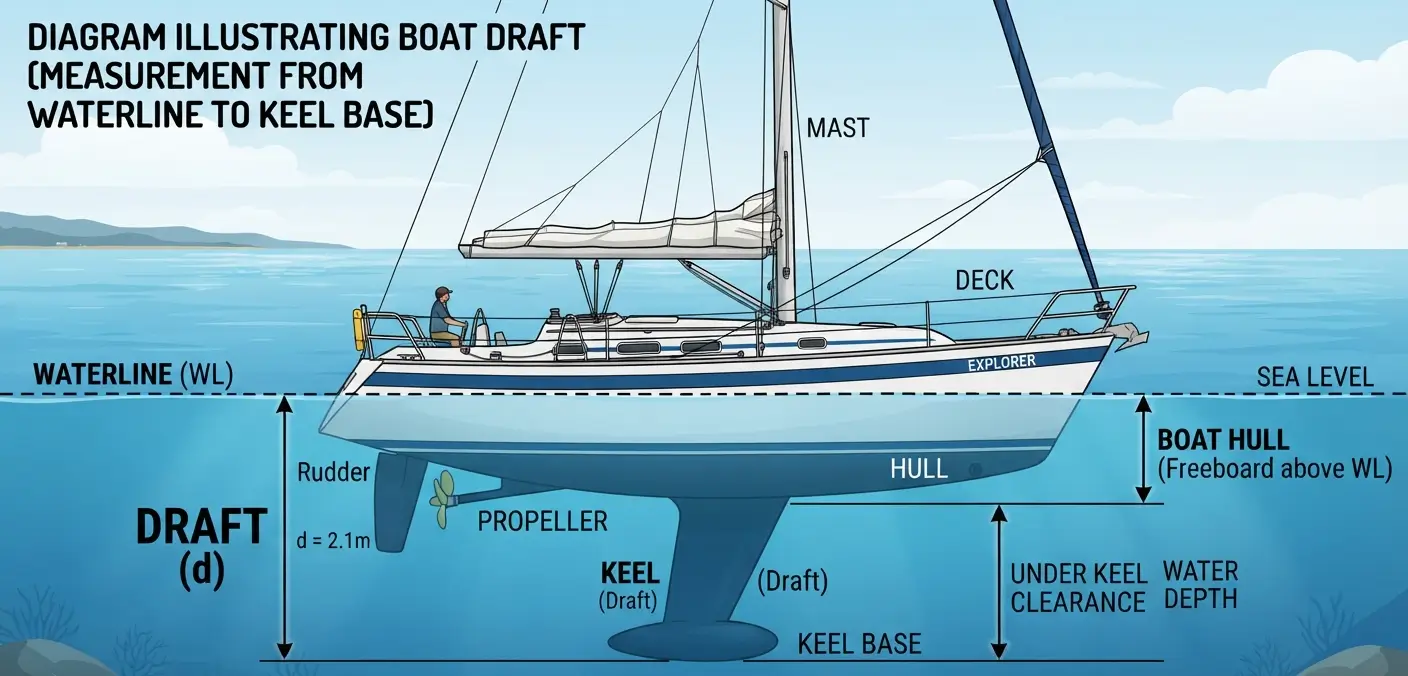
1. What is Boat Draft?
Draft is the vertical distance measured from the waterline down to the lowest point of the boat's underwater hull, drive system, or keel. Always remember that your maximum draft occurs when the engines or outdrives are fully lowered (trimmed down).
2. Measuring Draft Physically (In the Water)
The most accurate way to measure your boat's real-world draft is while it is fully loaded in the water:
- Load the Boat Normally: Fill fuel/water tanks and include typical gear and passenger weight to replicate actual operating conditions.
- Locate the Waterline: Standing on a dock or tender, locate where the water level hits the hull near the deepest part of the keel.
- Measure Downward: Drop a measuring rod or weighted measuring tape vertically from the waterline to the bottom edge of the keel, skeg, or lowered prop.
3. Interactive Draft Calculator (Estimating Math)
If your boat is out of the water, you can estimate displacement draft using hull dimensions and boat weight. Select your preferred measurement system and enter your values below for an automatic calculation.
Auto Draft Estimator
*Note: The mathematical formula used above calculates submerged volume using Archimedes' Principle ($\text{Volume} = \frac{\text{Displacement Weight}}{\text{Water Density}}$) multiplied by the hull block coefficient factor. Always add a safety margin for outdrives or props.
4. Essential Tips for Safe Clearance
- Account for Trim Angle: Outboards and sterndrives extend below the hull line when trimmed down. Always add this distance to your hull draft.
- Freshwater vs. Saltwater Difference: Saltwater is denser than freshwater. A boat floats slightly higher in saltwater and sits slightly deeper in freshwater.
- Dynamic Draft (Squatting): When running at speed, a planing hull rises, decreasing draft. However, at transitional speeds (displacement mode), the stern digs in and temporarily increases draft.