How to Measure Boat Windshield Support Bars
Learn how to measure boat windshield support bars correctly before ordering a replacement. This guide explains bar length, tube diameter, mounting-hole spacing, bracket dimensions, pivot locations, angles, and the measurements needed for a proper replacement fit.
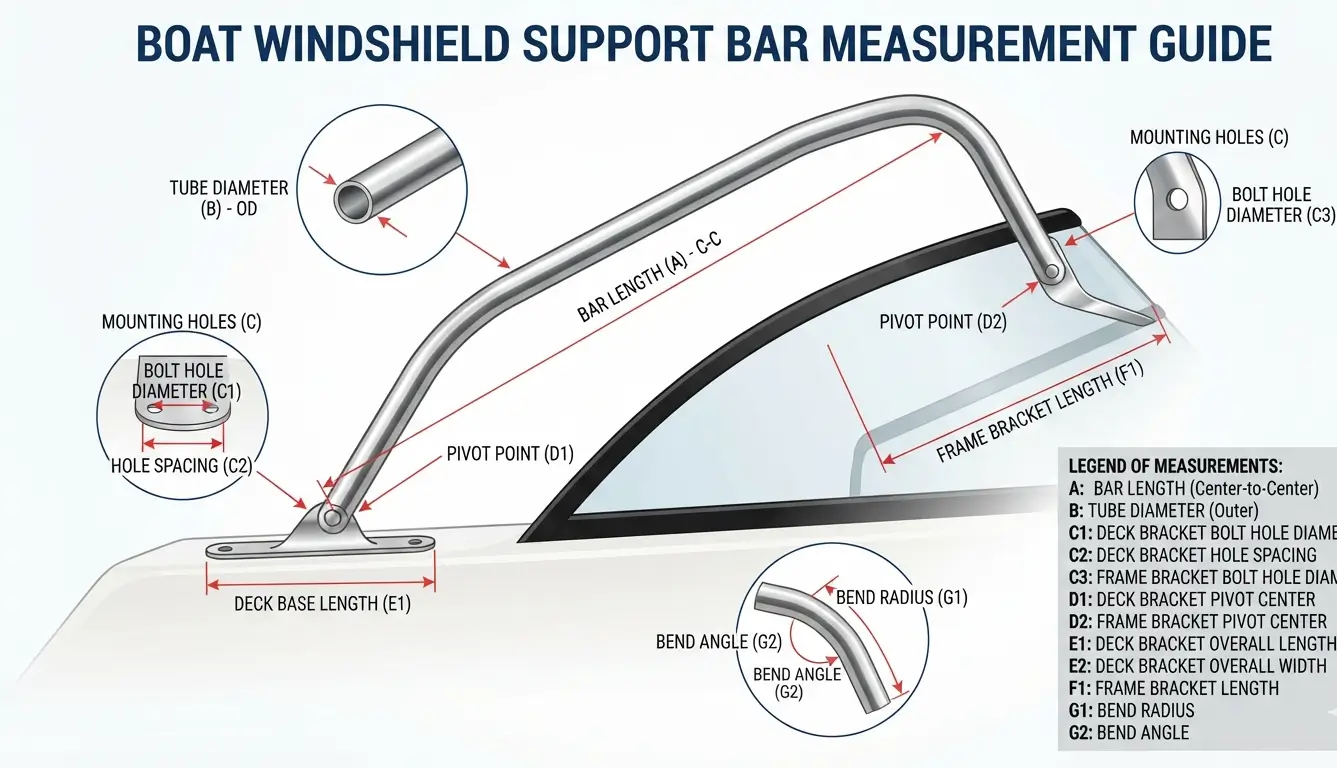
What measurements do you need for a boat windshield support bar?
The most useful measurements are:
- Overall support-bar length
- Mounting-center to mounting-center length
- Tube outside diameter
- Tube wall or inside diameter when required
- Mounting-hole diameter
- Hole-to-hole spacing
- Bracket width
- Pivot or hinge position
- Thread size and hardware type
- Installed angle
The exact measurements depend on whether you are replacing the entire support bar, only the tube, or one of the mounting brackets.
How do you measure the length of a boat windshield support bar?
The most useful dimension is usually the distance between the centers of the two mounting points. This describes the functional length of the installed support bar.
You should also record the physical end-to-end length because different mounting ends can extend beyond their actual pivot or bolt centers.
Functional Length: mounting center → mounting center
Overall Length: physical end → physical end
When ordering a replacement, provide both measurements whenever possible.
Should you measure a windshield support bar installed or removed?
Measure it while installed first, then remove it if necessary for more detailed measurements. The installed position helps preserve the correct mounting geometry and angle.
Removing the bar can make it easier to measure tube diameter, brackets, threaded ends, and hidden hardware.
How do you measure windshield support bar tube diameter?
Measure the outside diameter of the tube using a caliper whenever possible. This is the most useful measurement when ordering a replacement tube, clamp, bushing, hinge, or fitting.
A tape measure can provide an approximate circumference, but the diameter can then be calculated from the circumference:
$$Diameter = \frac{Circumference}{\pi}$$
Do not confuse outside diameter with inside diameter or nominal tubing size.
How do you measure the mounting holes on a windshield support bar?
Measure the diameter of each mounting hole and the distance between the hole centers.
Hole spacing should be measured center-to-center rather than edge-to-edge.
Hole Spacing: center of hole 1 → center of hole 2
Also record whether the hole is round, slotted, countersunk, or uses another mounting arrangement.
How do you measure a windshield support bracket?
Measure the bracket width, height, mounting-hole diameter, hole spacing, and distance from the bracket mounting surface to the pivot center.
If the bracket is angled, measure its orientation as well. A bracket that appears visually similar can still place the windshield support several millimeters away from its original mounting position.
| Measurement | Why It Matters |
|---|---|
| Tube diameter | Determines compatible tubing and fittings. |
| Overall bar length | Identifies the physical replacement size. |
| Center-to-center length | Defines the installed support geometry. |
| Hole diameter | Determines suitable bolts or pins. |
| Hole spacing | Allows the replacement bracket to use the existing mounting points. |
| Pivot location | Ensures the support folds and moves correctly. |
How do you measure a windshield support bar angle?
The support-bar angle can matter when the bar controls the position of a windshield panel or frame.
Measure the angle relative to a clearly defined reference, such as the deck surface, windshield frame, or vertical plane.
If the angle is difficult to measure directly, take a photo of the installed bar from the side and record the position of both mounting centers. A fabricator can use these references to reproduce the geometry.
Why is mounting-center distance important?
Two support bars can have the same overall physical length but different mounting-center distances because their end fittings differ.
For that reason, center-to-center measurements are often more useful than simply measuring from one end of the tube to the other.
How do you measure a telescoping windshield support bar?
Measure the minimum and maximum usable lengths of the support. Also record the diameter of each telescoping section and the locations of adjustment holes or locking pins.
Minimum Length: fully retracted mounting-center distance
Maximum Length: fully extended mounting-center distance
The locking-hole spacing is especially important if you need an adjustable replacement.
How do you measure a windshield support bar with pivot ends?
When both ends pivot, measure from the center of one pivot to the center of the other pivot. Then record the pivot-pin diameter and bracket thickness.
Also note the direction in which each pivot rotates. Matching the correct pivot orientation can be just as important as matching the length.
How do you measure the threads on a windshield support bar?
If the bar uses threaded hardware, record the thread diameter, pitch, and thread orientation. A thread gauge or caliper can help identify the size.
Do not rely only on the apparent bolt diameter because similar-looking metric and imperial threads may not be interchangeable.
Should you measure the windshield itself?
Yes, especially when replacing a support that determines the position or opening angle of the windshield.
Record the windshield panel dimensions, frame thickness, hinge position, support mounting points, and the gap between the windshield and adjacent panels.
How do you measure a windshield support bar for replacement?
- Photograph the entire support while installed.
- Measure mounting-center to mounting-center length.
- Measure the physical overall length.
- Measure tube outside diameter.
- Measure both mounting-hole diameters.
- Measure hole-to-hole spacing where applicable.
- Record pivot-pin diameter and bracket thickness.
- Record thread size and hardware.
- Measure the installed support angle.
- Compare all dimensions with the replacement manufacturer's specifications.
What are the most common boat windshield support measuring mistakes?
- Measuring only the tube length.
- Ignoring mounting-center distance.
- Confusing outside tube diameter with inside diameter.
- Measuring hole edges instead of hole centers.
- Ignoring pivot orientation.
- Forgetting thread pitch.
- Ignoring the support's installed angle.
- Not measuring both mounting ends.
- Assuming visually similar brackets are dimensionally identical.
How to measure boat windshield support bars step by step
- Leave the support installed and identify both mounting points.
- Measure center-to-center length.
- Remove the support if detailed hardware measurements are needed.
- Measure tube diameter.
- Measure mounting holes and pivot pins.
- Measure bracket thickness and width.
- Record threads and hardware sizes.
- Measure the support angle and windshield position.
- Photograph the original installation.
- Use all measurements together when ordering the replacement.
Boat windshield support bar FAQ
The mounting-center to mounting-center distance is usually one of the most important dimensions because it determines the installed geometry. Tube diameter and mounting hardware are also critical for compatibility.
Measure end-to-end, but also measure center-to-center between the mounting points. The center-to-center measurement is often more useful for finding a correct replacement.
Measure the outside diameter with a caliper. If a caliper is not available, measure the circumference and divide it by pi for an approximate outside diameter.
Measure the hole diameter and the center-to-center distance between holes. Also identify whether the holes are round, slotted, countersunk, or designed for a pivot pin.
Not automatically. A different length can change the windshield angle, loading, folding movement, and bracket geometry. The replacement should match the intended mounting geometry.
Measure it when the support bar controls windshield position or opening. Matching the original geometry helps ensure the windshield operates correctly after replacement.