How to Measure a Pontoon Boat
Learn how to measure a pontoon boat correctly, including overall length, beam, pontoon diameter, deck dimensions, transom height, draft, and weight. These measurements are useful when buying a boat cover, trailer, lift, flooring, motor, or replacement accessories.
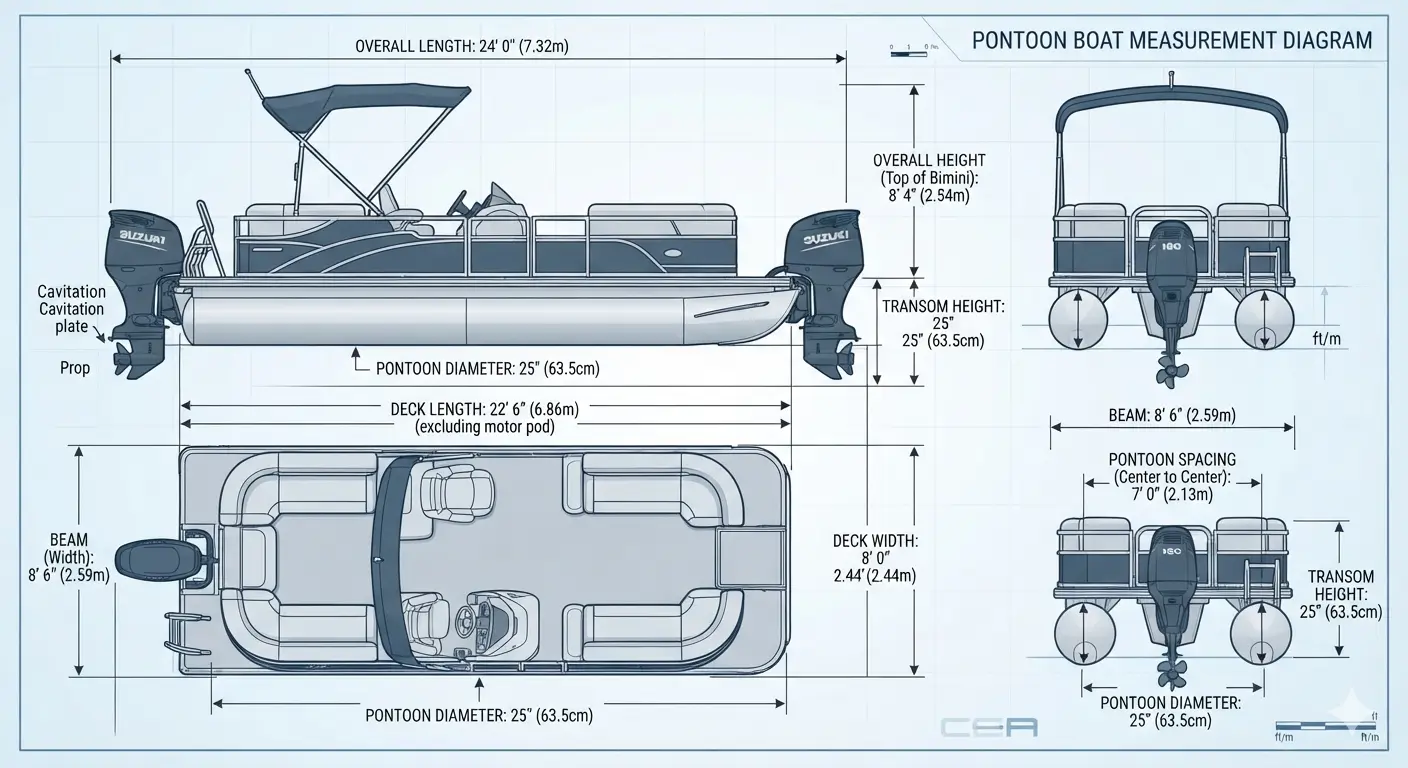
What measurements do you need for a pontoon boat?
For a general pontoon boat size record, measure:
- Overall length
- Maximum beam
- Deck length
- Deck width
- Pontoon diameter
- Distance between pontoons
- Transom width
- Transom height
- Draft
- Boat weight
Depending on the project, you may also need console dimensions, railing height, seat layout, storage dimensions, lifting points, and the position of the outboard.
How do you measure pontoon boat length?
Measure the length of the boat from the foremost point of the hull or deck structure to the rearmost point of the boat according to the measurement convention relevant to your purpose.
Do not automatically include the outboard motor, propeller, swim platform, trailer tongue, or other removable equipment unless the manufacturer specifically defines overall length that way.
Pontoon Length: front of boat → rear of boat
Published pontoon lengths can sometimes differ slightly from your tape-measure result because manufacturers use specific dimensional conventions.
How do you measure pontoon boat beam?
Beam is the maximum overall width of the pontoon boat. For most practical purposes, measure from the outside edge of one pontoon or widest structure to the outside edge of the opposite side.
Beam is particularly important for boat lifts, trailers, storage, slip fit, and transportation.
Maximum Beam: widest outside-to-outside dimension
How do you measure pontoon deck width?
Measure across the usable deck from one deck edge to the opposite deck edge. This is different from the overall beam because the pontoons can extend beyond the deck structure.
Deck width is especially useful when planning flooring, decking, furniture, storage systems, and replacement deck material.
How do you measure pontoon deck length?
Measure the usable deck length from the forward deck edge to the rear deck edge. If the boat has a bow section, motor pod, swim platform, or other extended areas, record those dimensions separately.
A boat may have a nominal overall length that differs from the actual usable deck length.
How do you measure pontoon diameter?
Pontoon diameter is the outside diameter of the cylindrical or rounded pontoon tube. Measure across the widest part of the pontoon from outside surface to outside surface.
A caliper can provide a more precise measurement, but a tape measure or straightedge can usually provide a practical estimate for a replacement or accessory project.
Pontoon Diameter: outside edge → outside edge at widest point
Why is pontoon diameter important?
Pontoon diameter affects the underwater volume and therefore the buoyancy available from the pontoons. It is also useful when ordering replacement components, lifting equipment, or flotation-related parts.
Larger pontoons generally provide more displaced volume for a given submerged length, but buoyancy also depends on pontoon shape, length, loading, and how deeply the pontoons sit in the water.
How do you measure the distance between pontoon tubes?
If you need the spacing for a lift, bracket, trailer, or structural component, measure the distance between the pontoons using a clearly defined reference.
Record whether the measurement is outside-to-outside, inside-to-inside, or center-to-center because these measurements are not interchangeable.
| Measurement | Use |
|---|---|
| Outside-to-outside | Overall pontoon assembly width. |
| Inside-to-inside | Clear space between the pontoons. |
| Center-to-center | Useful for structural brackets and lifting equipment. |
How do you measure pontoon boat transom height?
Measure vertically from the motor-mounting surface at the transom down to the appropriate bottom reference of the boat.
Transom height is important when selecting an outboard because it helps determine the appropriate shaft length.
Transom Height: top of motor-mounting surface → bottom reference
Always compare the measurement with the engine manufacturer's recommended shaft length and the boat manufacturer's specifications.
How do you measure pontoon boat draft?
Draft is the vertical distance from the waterline to the lowest submerged part of the boat or pontoon under a defined loading condition.
Measure the draft while the pontoon is floating in calm water and make a note of how the boat is loaded.
$$Draft = Waterline\ to\ Lowest\ Submerged\ Point$$
The outboard lower unit, propeller, transducer, or other components may extend below the pontoons, so specify whether you are measuring hull draft or the lowest operating component.
How do you measure a pontoon boat for a cover?
Start with overall length and maximum beam, but do not stop there. Pontoon covers often need to account for rail height, windshield height, consoles, seating arrangement, bow shape, stern configuration, and other structures.
For a replacement cover, compare your measurements with the cover manufacturer's sizing chart and installation requirements.
- Measure overall boat length.
- Measure maximum beam.
- Measure railing height.
- Measure windshield or console height if applicable.
- Record bow and stern shape.
- Note towers, fishing seats, ladders, and other protrusions.
How do you measure a pontoon boat for a trailer?
Trailer selection usually requires more than length and beam. Record the boat's loaded transport weight, pontoon spacing, pontoon diameter, transom configuration, and the locations where the trailer will support the pontoons.
$$Transport\ Weight = Boat + Motor + Fuel + Batteries + Gear$$
The trailer's rated capacity must be sufficient for the complete transport load, not merely the published dry hull weight.
How do you measure a pontoon boat for a boat lift?
A boat lift may require overall beam, pontoon diameter, spacing, hull length, lift-point locations, and loaded weight.
Measure the distance between the pontoons carefully and identify whether the lift specification uses inside spacing, outside spacing, or center-to-center spacing.
Also check the lift manufacturer's required minimum and maximum pontoon dimensions before selecting equipment.
How do you measure a pontoon boat's weight?
For a planning calculation, start with the manufacturer's published weight for the exact model and configuration. For transportation, the actual weight can be substantially higher once the motor, fuel, batteries, furniture, equipment, and gear are included.
How do you measure a pontoon boat for flooring?
Measure the usable deck area rather than the overall boat dimensions. Measure deck length and width at several locations because the bow may taper or have a different shape from the main deck.
Record the locations of seats, helm consoles, storage compartments, railings, doors, and other obstacles if you are ordering custom flooring.
$$Deck\ Area \approx Deck\ Length \times Deck\ Width$$
For irregular bow areas, split the deck into simpler shapes or make a full-size template for greater accuracy.
How do you measure a pontoon boat for a replacement deck?
Measure the actual structural deck dimensions and inspect how the deck is supported. Record the thickness of the existing decking, framing spacing, access openings, and the locations of seats and permanent structures.
Do not assume the overall pontoon length is the same as the length of the deck panels.
How do you measure a pontoon boat for an outboard?
Measure transom height and then check the boat's maximum horsepower, maximum engine weight, and manufacturer recommendations.
The boat's overall length alone is not enough to determine the correct outboard size or shaft length.
What is the difference between pontoon boat length and deck length?
Overall length describes the boat's complete hull or structural dimension according to the selected measurement convention. Deck length describes the usable deck area.
The two measurements can differ because of bow structure, stern extensions, motor pods, or other design features.
What are the most common pontoon boat measuring mistakes?
- Confusing overall beam with deck width.
- Confusing pontoon diameter with draft.
- Using deck length as overall boat length.
- Including the trailer or outboard in the hull measurement.
- Forgetting to measure pontoon spacing.
- Using dry weight for a fully loaded trailer calculation.
- Not recording whether spacing is inside-to-inside or center-to-center.
- Measuring only one deck section when ordering flooring.
- Ignoring rail, windshield, or console height when buying a cover.
How to measure a pontoon boat step by step
- Measure the overall boat length.
- Measure maximum outside beam.
- Measure usable deck length.
- Measure usable deck width.
- Measure pontoon diameter.
- Measure pontoon spacing.
- Measure transom height and width.
- Measure draft under the intended loading condition.
- Record the actual or published boat weight.
- Record any dimensions required by the specific accessory or equipment manufacturer.
Pontoon boat measurement FAQ
It depends on the project. Overall length and beam are important for general sizing, while pontoon diameter and spacing are often critical for lifts, trailers, and structural accessories.
No. Overall boat length and usable deck length can differ depending on the bow, stern, motor pod, and other structural features.
Measure overall length, maximum beam, rail and windshield height, and note consoles, seating, bow shape, and other protrusions. Then compare the measurements with the cover manufacturer's chart.
Measure the distance between the pontoons using the reference specified for your project, such as inside-to-inside, outside-to-outside, or center-to-center.
Record beam, pontoon diameter, pontoon spacing, overall length, loaded weight, and the locations where the lift will support the pontoons. Then compare those values with the lift manufacturer's specifications.
Use the complete loaded transport weight, including the boat, outboard, fuel, batteries, and equipment, rather than relying only on the dry boat weight.