How to Measure a Boat Hatch
Learn how to measure a boat hatch correctly before ordering a replacement or installing a new hatch. This guide explains how to measure the opening, hatch dimensions, flange, thickness, corner radius, and mounting details.
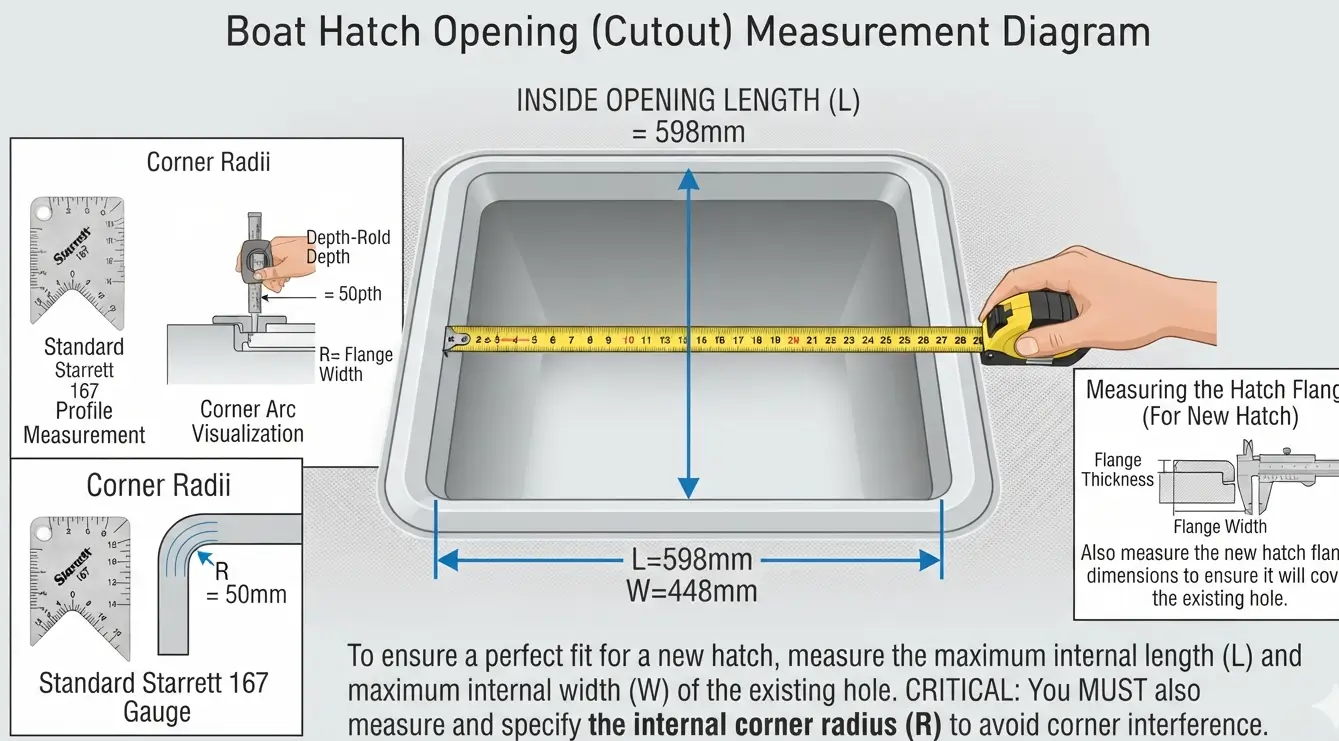
How to Measure a Boat Hatch Step by Step
- Remove the old hatch or open it fully so the surrounding structure can be inspected.
- Measure the opening length and width where the hatch actually needs to fit.
- Measure the outside dimensions of the existing hatch if one is already installed.
- Measure the mounting flange or frame width.
- Measure the hatch thickness and the deck thickness around the opening.
- Check whether the corners are square, rounded, or have a specific radius.
- Record hinge, latch, screw-hole, and mounting locations if the replacement needs to use the existing holes.
1. How do you measure the boat hatch opening?
The hatch opening is usually the most important measurement when replacing a hatch. Measure the actual clear opening in the deck, rather than simply measuring the outside of the hatch frame.
Measure the opening from one inside edge to the opposite inside edge. Take both the length and the width.
Opening Length: inside edge to inside edge
Opening Width: inside edge to inside edge
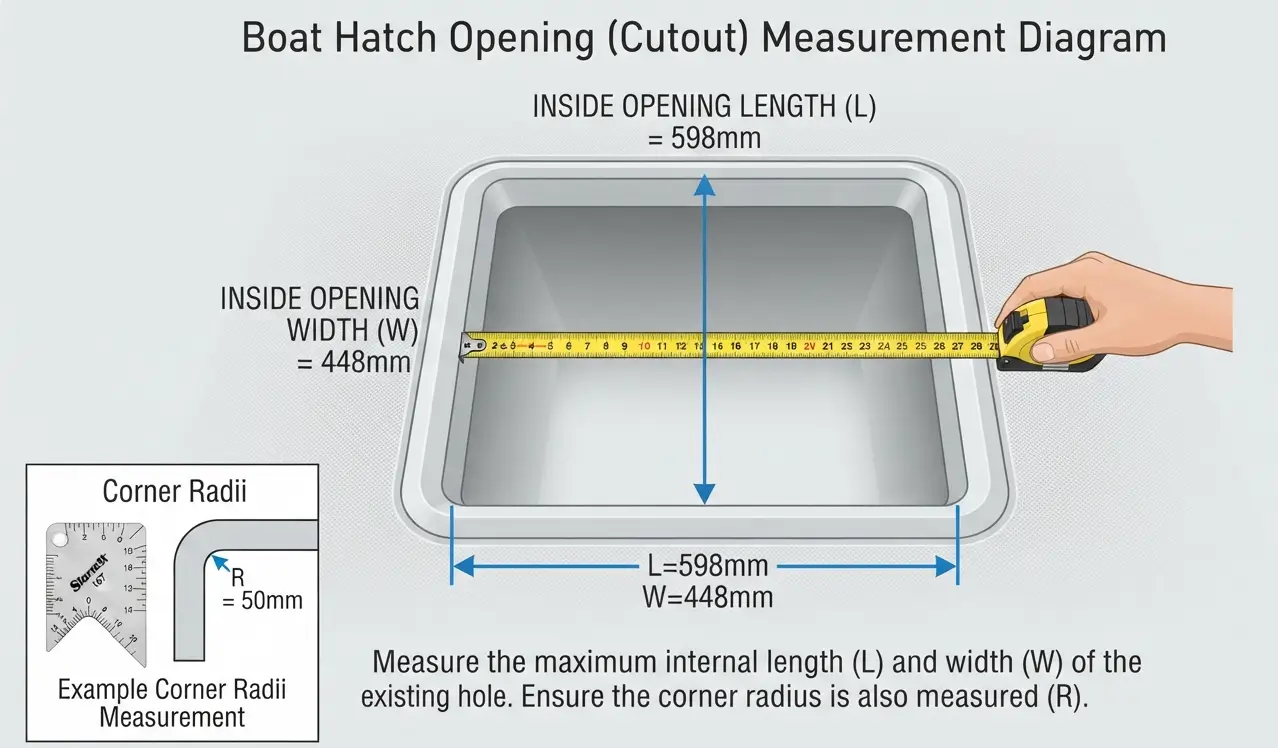
Measure the opening in at least two places if possible. An older fiberglass or composite deck can have slightly irregular dimensions, and the opening may not be perfectly square.
2. Should you measure the inside or outside of a boat hatch?
Measure both when replacing an existing hatch.
The inside opening tells you whether the new hatch will physically fit the cutout. The outside dimensions tell you whether the new flange or frame will cover the existing opening and screw holes.
| Measurement | Why It Matters |
|---|---|
| Clear opening length | Determines the size of opening the hatch must fit. |
| Clear opening width | Determines the required opening width. |
| Outside hatch length | Shows how much deck area the hatch and flange cover. |
| Outside hatch width | Useful when checking replacement coverage. |
| Flange width | Helps determine whether the replacement will cover the cutout. |
| Corner radius | Important for hatches with rounded corners. |
3. How do you measure the corner radius of a boat hatch?
Many boat hatches have rounded corners rather than perfectly square corners. The corner radius is the distance from the center of the imaginary circle to the curved edge.
A practical way to measure it is to place a ruler across the straight sections near the corner and measure the approximate radius of the curve. Comparing the hatch to radius templates can provide a more accurate result.
When ordering a replacement hatch, use the manufacturer's specified corner-radius measurement whenever possible.
4. How do you measure boat hatch thickness?
Measure the thickness of the hatch lid or panel at its thickest structural area. Also measure the thickness of the deck surrounding the hatch.
Thickness matters because some replacement hatches are designed for a particular deck thickness or mounting flange arrangement.
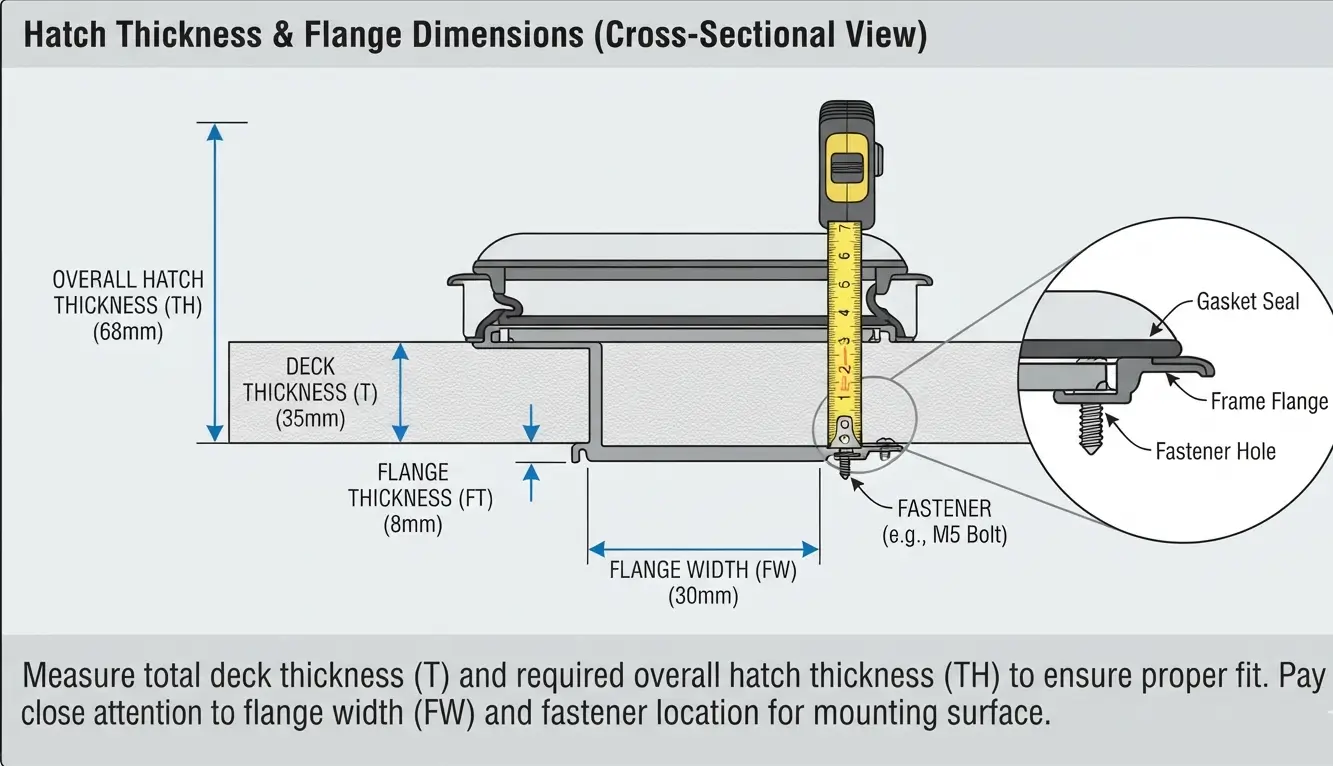
5. What is the flange on a boat hatch?
The flange is the part of the hatch frame that rests on top of or against the surrounding deck. It provides the mounting surface and helps cover the edge of the cutout.
When replacing a hatch, the flange must be large enough to provide adequate support and, where applicable, cover the existing opening and mounting area.
6. Should you measure the screw holes?
Yes, especially when you want to install the replacement hatch without drilling new holes.
Record the distance between mounting holes, their distance from the hatch edges, hole diameter, and the number of holes around the frame. A replacement hatch may have the correct opening dimensions but a different mounting-hole pattern.
7. Do you need to measure the hatch hinge?
Measure the hinge if the hinge location or orientation needs to match the existing installation. Record the hinge length, hinge position, distance from the edge, and direction in which the hatch opens.
This is especially useful when replacing a hatch that is integrated into a specific deck layout.
8. Is the hatch size the same as the opening size?
No. A hatch's advertised or nominal dimensions may refer to the opening size, outside frame size, or another manufacturer-defined dimension.
Always check exactly what dimension a manufacturer is describing before ordering.
Nominal hatch size ≠ necessarily outside dimensions ≠ necessarily clear opening
9. How do you measure an irregular boat hatch?
If the hatch is not rectangular, divide the opening into simpler geometric sections and record each measurement. For unusual shapes, make a cardboard or paper template of the opening.
A full-size template can be especially useful for custom hatches because it shows the exact shape and location of corners, hinges, latches, and obstacles.
10. What measurements do you need to replace a boat hatch?
For most replacement projects, record at least the following:
- Clear opening length
- Clear opening width
- Outside frame or hatch length
- Outside frame or hatch width
- Flange width
- Hatch thickness
- Deck thickness
- Corner radius
- Hinge position
- Latch position
- Mounting-hole pattern
11. What tools do you need to measure a boat hatch?
A basic measuring tape is usually enough for length and width. A ruler or caliper can help with thickness and hardware dimensions. For rounded corners, a radius gauge or template can improve accuracy.
Taking clear photos while measuring is also useful when comparing replacement hatch designs or discussing the dimensions with a supplier.
12. What are the most common boat hatch measuring mistakes?
The most common mistake is measuring only the outside of the old hatch and assuming that dimension is the required opening size.
Other common mistakes include ignoring corner radius, forgetting deck thickness, not checking screw-hole locations, measuring only one side of a slightly irregular opening, and confusing inches with millimeters.
13. What is the best way to measure a boat hatch for replacement?
The safest approach is to record the opening, outside dimensions, flange, thickness, corner radius, and mounting pattern rather than relying on a single measurement.
- Measure the clear opening.
- Measure the outside dimensions.
- Measure the flange and deck thickness.
- Measure corner radius.
- Record hinge and latch positions.
- Record the mounting-hole pattern.
- Compare the measurements with the manufacturer's drawing.
Boat Hatch Measurement FAQ
Yes. You can measure the visible opening, outside dimensions, frame, and hardware while the hatch is installed. Removing it, however, makes it easier to inspect the cutout and measure the flange, deck thickness, and mounting details accurately.
Use the unit specified by the manufacturer. Many marine products are listed in inches, while some European and metric products use millimeters. Do not round a measurement unnecessarily when the replacement needs a close fit.
Required clearance depends on the specific hatch design and installation method. Do not invent a universal clearance value. Follow the manufacturer's required opening dimensions and installation instructions.
Sometimes, but it depends on the surrounding deck structure, flange coverage, opening size, mounting hardware, and whether enlarging the opening is structurally acceptable. A larger hatch should not be assumed to be a direct replacement.
For a custom-size hatch, create a precise template of the opening and record all dimensions. A manufacturer or fabricator can use the template and dimensions to produce a replacement.
A verified model number can be useful, but measuring the actual installation is still a good idea because the hatch may have been modified, the opening may differ from the original specification, or several revisions of the same product may exist.