How to Measure a Boat Bimini Top
Learn how to measure a boat bimini top correctly before buying a replacement. This guide explains how to measure bimini width, length, height, mounting points, frame spacing, and clearance so you can choose the right size.
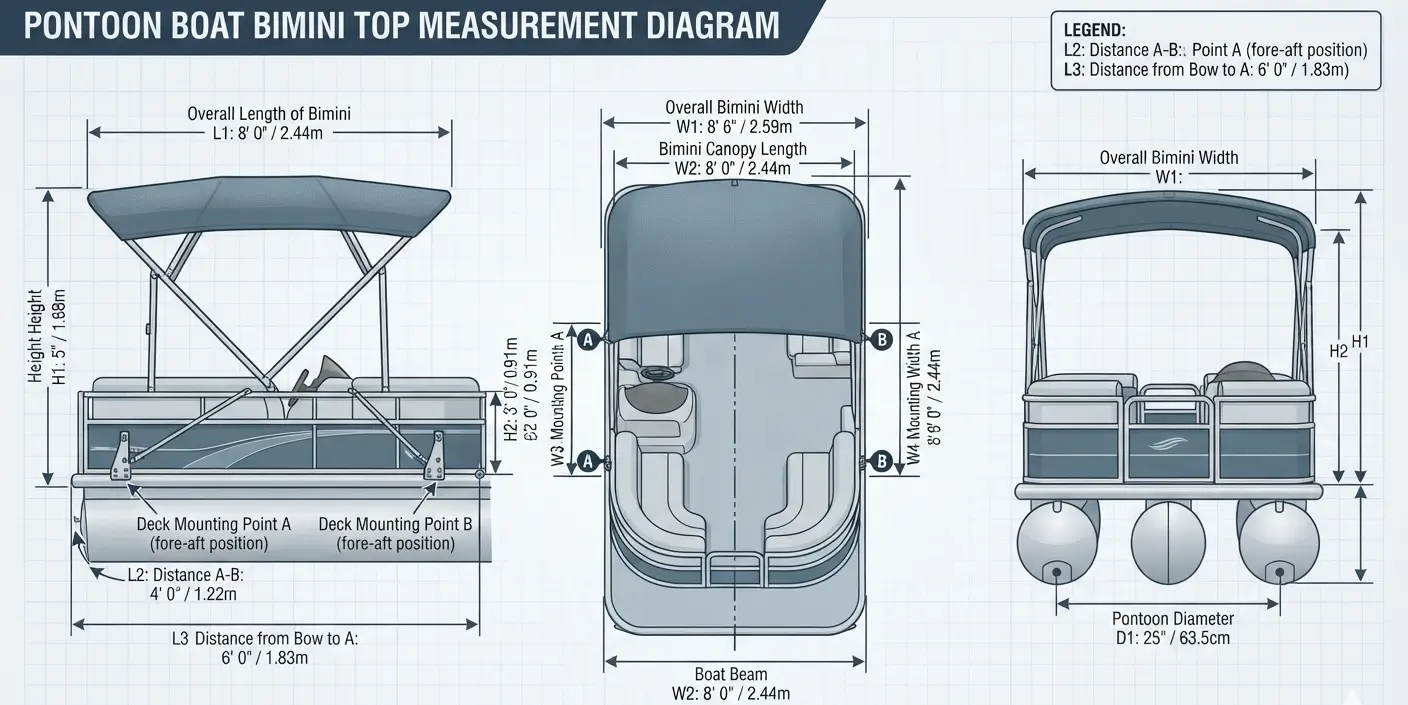
What measurements do you need for a boat bimini top?
The main measurements are:
- Bimini width
- Bimini length
- Bimini height
- Mounting-point width
- Mounting-point positions
- Available fore-and-aft mounting space
- Clearance above seats, consoles, and windshields
- Existing frame tube size, if replacing the frame
For a replacement cover only, you may also need the frame's folding position and the attachment arrangement for the existing hardware.
How do you measure bimini top width?
Width is normally measured across the boat from one side mounting position to the corresponding mounting position on the opposite side. Measure across the boat rather than along the centerline.
For the most useful result, measure the intended mounting points at the level where the bimini brackets will actually be installed.
Bimini Width: left mounting point → right mounting point
Do not assume the boat's maximum beam is the correct bimini width. The mounting points may be inside the maximum beam.
Is bimini width the same as boat beam?
No. Boat beam is the maximum overall width of the hull, while bimini width describes the span required at the frame's mounting locations.
A bimini top can therefore have a smaller width than the boat's maximum beam and still fit correctly.
| Measurement | Meaning |
|---|---|
| Boat beam | Maximum overall width of the boat. |
| Bimini width | Distance between the intended side mounting positions. |
| Deck width | Usable width of the deck or cockpit. |
How do you measure bimini top length?
Bimini length is the fore-and-aft coverage of the top when it is deployed. Measure the amount of cockpit or seating area you want the bimini to cover.
Common bimini lengths vary by boat and application, so the correct length depends on the coverage you want rather than simply the boat's overall length.
Bimini Length: forward coverage point → aft coverage point
How do you measure bimini top height?
Measure vertically from the location where the bimini frame will mount to the desired height of the top above the boat.
The correct height should provide enough clearance for people to sit, stand, operate the boat, and use the helm without the frame or canvas interfering with normal operation.
Bimini Height: mounting surface → desired top clearance
Measure clearance from the actual mounting location rather than from the floor if the brackets are mounted on a raised gunwale or deck.
How much clearance should a bimini top have?
There is no single universal clearance because the required height depends on the boat, seating arrangement, helm position, windshield, intended use, and the bimini frame design.
The top should provide adequate clearance without interfering with navigation visibility, steering, seating, controls, or other boat equipment.
How do you measure the mounting points for a bimini?
Identify the exact locations where the side brackets or mounting feet will attach to the boat. Measure the distance across the boat between the corresponding left and right mounting points.
Also measure how far each mounting point is from nearby edges, seats, consoles, rails, and other structures.
- Mark the existing left mounting point.
- Mark the existing right mounting point.
- Measure the distance between them.
- Measure each point's fore-and-aft position.
- Record the bracket orientation and mounting surface.
How do you measure a boat bimini top for replacement?
If an old bimini is already installed, measure both the existing frame and the actual boat mounting locations.
Record the width, deployed length, height, frame tube diameter, bracket type, hinge position, and location of support straps or rear braces.
This is safer than ordering a new cover from the nominal boat length alone.
Should you measure the bimini frame or the boat?
Measure both when replacing an existing system. The boat measurements establish what can physically fit, while the frame measurements help identify whether the replacement canvas or frame is compatible.
If you are replacing only the canvas, the existing frame geometry is especially important.
How do you measure a bimini top for a pontoon boat?
For a pontoon boat, measure the actual distance between the side mounting positions rather than simply using the published pontoon beam. Also record rail height, console height, windshield position, seating location, and available fore-and-aft space.
Pontoon boats often have large seating areas, so bimini length becomes particularly important when deciding how much of the passenger area should be shaded.
How do you measure a bimini top for a bass boat?
On a bass boat, pay particular attention to the mounting surface, front and rear deck layout, raised seats, consoles, and fishing positions.
The correct bimini should not block important controls or prevent normal movement around the cockpit.
How do you measure a bimini top for a runabout?
For a runabout, measure the cockpit width between the planned mounting points, the desired fore-and-aft coverage, and the required height above the seats and windshield.
If the windshield is tall, verify that the bimini can deploy and fold without interfering with the windshield or frame.
How do you measure bimini frame tube diameter?
If you need replacement frame hardware or tubing, measure the outside diameter of the frame tube with a caliper if possible.
A tape measure can give an estimate, but a caliper is preferable when purchasing clamps, hinges, end fittings, or replacement tubing.
How do you measure the bimini top fabric?
Measuring the fabric itself is less reliable than measuring the frame because the fabric can stretch, shrink, sag, or change shape with age.
For replacement canvas, measure the frame dimensions and mounting geometry first and compare them with the manufacturer's pattern requirements.
How do you measure a bimini top for a boat cover?
A bimini top and a boat cover are different systems. If you need a boat cover that fits over a deployed or folded bimini, measure the bimini's maximum height and width in the relevant position.
Tell the cover manufacturer whether the bimini will be folded forward, folded aft, or fully deployed beneath the cover.
What are the most common bimini measuring mistakes?
- Using boat beam as bimini width.
- Measuring from the wrong mounting locations.
- Ignoring windshield and console height.
- Choosing bimini length from overall boat length alone.
- Measuring the old stretched fabric instead of the frame.
- Forgetting the fore-and-aft position of mounting brackets.
- Not checking whether the folded bimini clears nearby equipment.
- Confusing frame height with total standing clearance.
- Not recording the frame tube diameter when replacing hardware.
How to measure a boat bimini top step by step
- Identify the exact side mounting points.
- Measure the distance between the mounting points for width.
- Measure the desired fore-and-aft coverage for length.
- Measure vertically from the mounting surface for height.
- Check clearance over the windshield, console, and seats.
- Record the location of each mounting bracket.
- Measure existing frame tube diameter if replacing the frame.
- Record support strap and brace positions.
- Compare all dimensions with the manufacturer's sizing chart.
Boat bimini top measurement FAQ
Width, length, and height are the three primary dimensions, but the exact mounting-point locations are equally important when replacing an existing bimini.
No. Bimini width is the span between the actual mounting points, while beam is the boat's maximum overall width.
Measure the existing frame width, deployed length, frame height, mounting locations, and tube size. Do not rely only on the old canvas because fabric can stretch or change shape.
The appropriate height depends on the mounting location, seating, windshield, console, and intended use. Measure from the actual mounting surface and verify the finished clearance.
Choose the length based on the area you want shaded. Measure the fore-and-aft cockpit or seating area and compare it with the available bimini sizes from the manufacturer.
Only if the frame and mounting system are designed for that arrangement. A bimini should not be forced into a width that does not match the manufacturer's mounting range.