How to Calculate If a Boat Will Float
Learn how to determine whether a boat will float by comparing its weight with the buoyant force created by the water it displaces. This guide explains Archimedes' principle, displaced volume, water density, draft, freeboard, and practical boat flotation calculations.
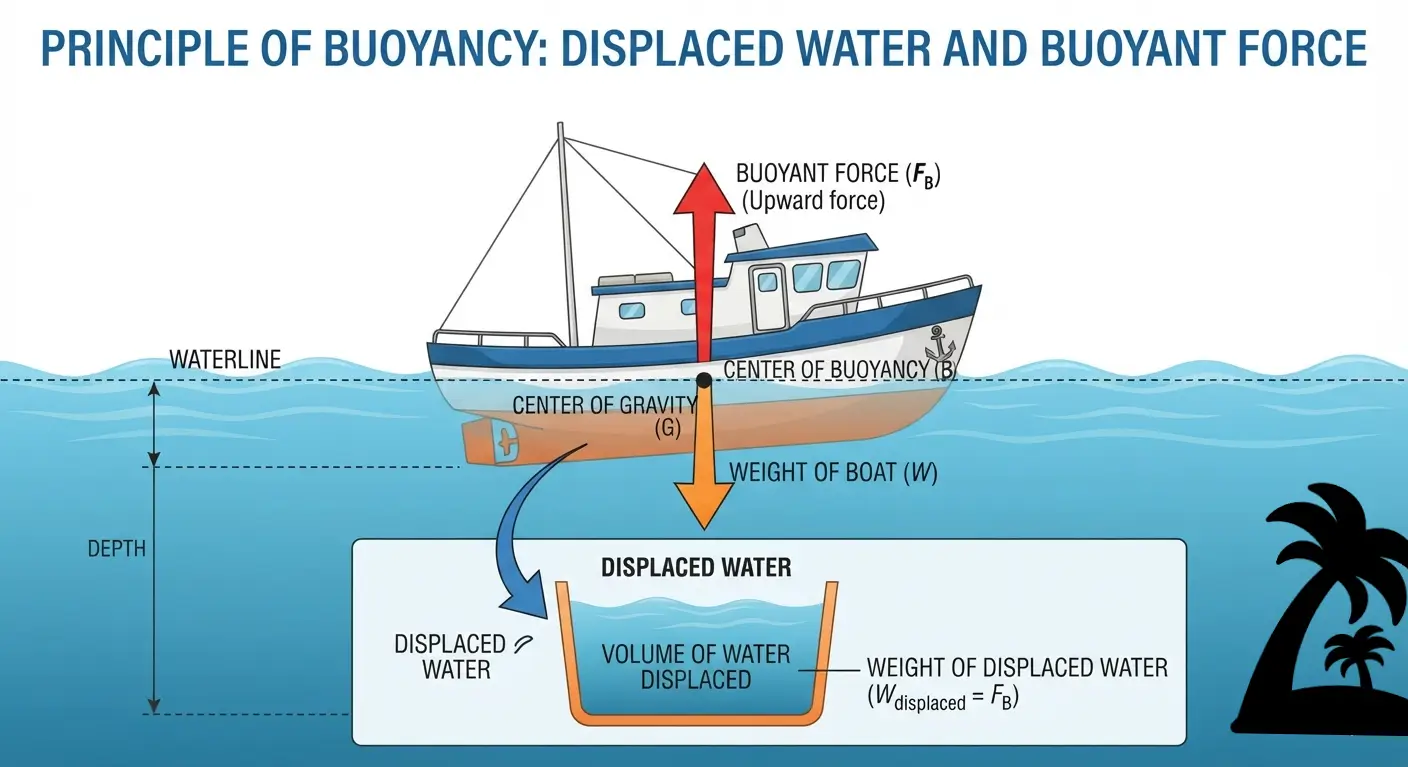
Why does a boat float?
A boat floats because the submerged part of the hull pushes water out of the way. The displaced water produces an upward buoyant force. When that upward force balances the boat's downward weight, the boat is in floating equilibrium.
$$Buoyant\ Force = Weight\ of\ Displaced\ Water$$
$$Floating\ Condition: Buoyant\ Force \geq Boat\ Weight$$
For a freely floating boat at equilibrium, the two forces are equal, not greater.
How do you calculate if a boat will float?
Start by calculating the boat's total weight. Then determine how much water the hull can displace at the intended draft. Multiply that displaced volume by the density of the water.
$$Maximum\ Supported\ Mass = Displaced\ Volume \times Water\ Density$$
If the available displaced-water mass is greater than or equal to the boat's total mass, the boat can theoretically float at that condition. If the boat's weight is greater, the hull cannot generate enough buoyancy at that displacement condition.
What is Archimedes' principle?
Archimedes' principle states that an object immersed in a fluid experiences an upward buoyant force equal to the weight of the fluid displaced by the object.
This principle is the foundation of boat flotation calculations. The hull does not need to be lighter than water as a solid object. What matters is the average density of the entire floating vessel and the volume of water the hull displaces.
What formula tells you whether a boat will float?
A basic flotation test can be written as:
$$V_{displaced} \times \rho_{water} \geq M_{boat}$$
Here, Vdisplaced is the submerged volume of the hull, ρwater is the water density, and Mboat is the total mass of the boat and its load.
When using consistent SI units, displaced volume is in cubic meters, water density is in kilograms per cubic meter, and mass is in kilograms.
What is the minimum displaced volume needed to float a boat?
Rearranging the flotation equation gives the minimum displaced volume needed to support a given mass.
$$V_{required} = \frac{M_{boat}} {\rho_{water}}$$
For example, in freshwater with a density of approximately 1,000 kg/m³, a 2,000 kg boat needs roughly 2 m³ of displaced water to support its mass.
How do you calculate boat buoyancy in freshwater?
Freshwater has a density of approximately 1,000 kg/m³ under ordinary conditions. Therefore, every cubic meter of displaced freshwater supports roughly 1,000 kg of mass.
$$Buoyant\ Mass \approx V_{displaced} \times 1000$$
The actual density varies with temperature and water composition, but the 1,000 kg/m³ approximation is useful for many preliminary calculations.
How do you calculate boat buoyancy in seawater?
Seawater is denser than freshwater. A commonly used approximate density is 1,025 kg/m³, although actual seawater density depends on salinity, temperature, and pressure.
$$Buoyant\ Mass \approx V_{displaced} \times 1025$$
This means a given submerged volume can support slightly more mass in seawater than in freshwater.
How can you tell if a boat is overloaded?
Overloading increases the boat's total weight. The vessel responds by sinking deeper, increasing the submerged volume and draft. Eventually, the boat can approach or exceed its safe loading condition.
$$More\ Load \rightarrow Greater\ Displacement \rightarrow Greater\ Draft \rightarrow Less\ Freeboard$$
Even before complete loss of flotation, reduced freeboard and deteriorating stability can make a boat unsafe.
How do you calculate if a homemade boat will float?
- Estimate the completed boat's total weight, including the hull, motor, batteries, passengers, fuel, and equipment.
- Estimate the submerged volume available at a practical draft.
- Determine the density of the water in which the boat will operate.
- Multiply submerged volume by water density to determine the supported mass.
- Compare supported mass with total boat mass.
- Check freeboard and stability rather than considering flotation alone.
A boat that technically floats can still be unsafe if it has too little freeboard or poor stability.
Can a boat float if it weighs more than water?
Yes. A boat can be constructed from materials that are individually denser than water and still float because the overall hull contains enough enclosed volume to displace water.
A steel ship is a classic example. The steel itself is much denser than water, but the ship's large enclosed hull gives the complete vessel an average density low enough to float at its operating displacement.
What is average density and why does it matter?
The average density of a boat is its total mass divided by its overall external volume.
$$Average\ Density = \frac{Total\ Mass} {Overall\ Volume}$$
A simplified comparison can be useful for understanding flotation: if the boat's average density is lower than the surrounding water, it can float. However, the actual floating condition also depends on hull geometry, enclosed volume, openings, loading, and stability.
How does hull shape affect whether a boat floats?
Hull shape determines how much water can be displaced at a particular draft. Two boats with the same weight can have different drafts because their underwater shapes are different.
| Hull characteristic | Effect on flotation |
|---|---|
| Wide underwater hull | Can produce more displacement at a given draft. |
| Deep hull | Can provide substantial submerged volume. |
| Fine/narrow hull | May require greater draft to displace the same volume. |
| Large enclosed volume | Can provide more buoyant volume when kept watertight. |
How does draft affect whether a boat floats?
Draft is the vertical distance from the boat's baseline or keel reference to the waterline. As the boat becomes heavier, it generally sinks deeper and draft increases until enough additional water is displaced to balance the load.
$$Weight \uparrow \Rightarrow Draft \uparrow \Rightarrow Displaced\ Volume \uparrow$$
What is freeboard and why is it important?
Freeboard is the vertical distance between the waterline and the selected upper reference on the vessel, such as the deck edge or gunwale.
A boat can have enough buoyancy to remain afloat but still have dangerously little freeboard. Low freeboard makes it easier for waves, spray, or wake to come aboard.
$$Freeboard = Hull\ Depth - Draft$$
Can a boat sink even if it has enough buoyancy?
Yes. Buoyancy is only part of the analysis. Flooding, water entering enclosed spaces, loss of reserve buoyancy, excessive heel, poor stability, structural failure, or freeboard becoming dangerously small can all lead to loss of safety.
How does water entering a boat affect flotation?
Water that enters an initially enclosed or protected space adds weight to the vessel. At the same time, flooded spaces can reduce the effective reserve buoyancy and can introduce free-surface effects.
This is why watertight integrity and compartmentation are important parts of boat safety.
Can you calculate flotation using length, width, and draft?
You can make a rough estimate for simple shapes. For a rectangular underwater volume:
$$V = Length \times Width \times Draft$$
Real boat hulls are not rectangular, so a block coefficient or a more accurate hull-volume model is normally needed for meaningful predictions.
How do you calculate the maximum weight a boat can support?
A theoretical buoyancy limit can be estimated from the maximum useful submerged volume:
$$Maximum\ Supported\ Mass = V_{max} \times \rho_{water}$$
But this is not the same as a certified safe loading capacity. Practical boat capacity also depends on freeboard, stability, structure, flooding considerations, and applicable requirements.
How can I calculate if a small boat will float with passengers?
Add the weights of the hull, motor, batteries, fuel, passengers, and equipment. Then compare the resulting total mass with the amount of displaced water at the intended draft.
$$Total\ Boat\ Mass = Hull + Motor + Fuel + Batteries + Passengers + Gear$$
If the total mass is greater than the supported mass at the intended condition, the boat will settle deeper until additional water is displaced or the vessel reaches a limiting condition.
What is the difference between floating and being safely afloat?
A boat can remain technically afloat while being unsafe. For example, it may have very little freeboard, excessive heel, poor stability, or insufficient reserve buoyancy.
A meaningful boat-loading assessment therefore needs more than a simple "will it float?" calculation.
Boat flotation FAQ
A boat floats when the buoyant force produced by the water it displaces balances the total weight of the boat and its load.
The boat must displace enough water that the weight of the displaced water equals the boat's total weight. The required volume is mass divided by water density.
Generally yes. A heavier floating boat must displace more water, which normally means a greater submerged volume and greater draft.
For the same boat weight and hull condition, denser seawater generally supports the vessel with slightly less displaced volume, so the boat typically floats at a slightly smaller draft.
Yes. A watertight concrete hull can float if its overall average density and displaced volume are sufficient to support its total weight.
No. You also need information about the hull's available displacement volume and the water in which it will operate.
No. Buoyancy determines whether the boat can be supported by the water, while stability describes how the boat responds to changes in heel and loading.