How to Calculate Fresh Water Allowance for a Ship?
Learn how fresh water allowance (FWA) is calculated for a ship, which formula to use, what TPC means, how water density affects draft, and how to calculate the allowance step by step.
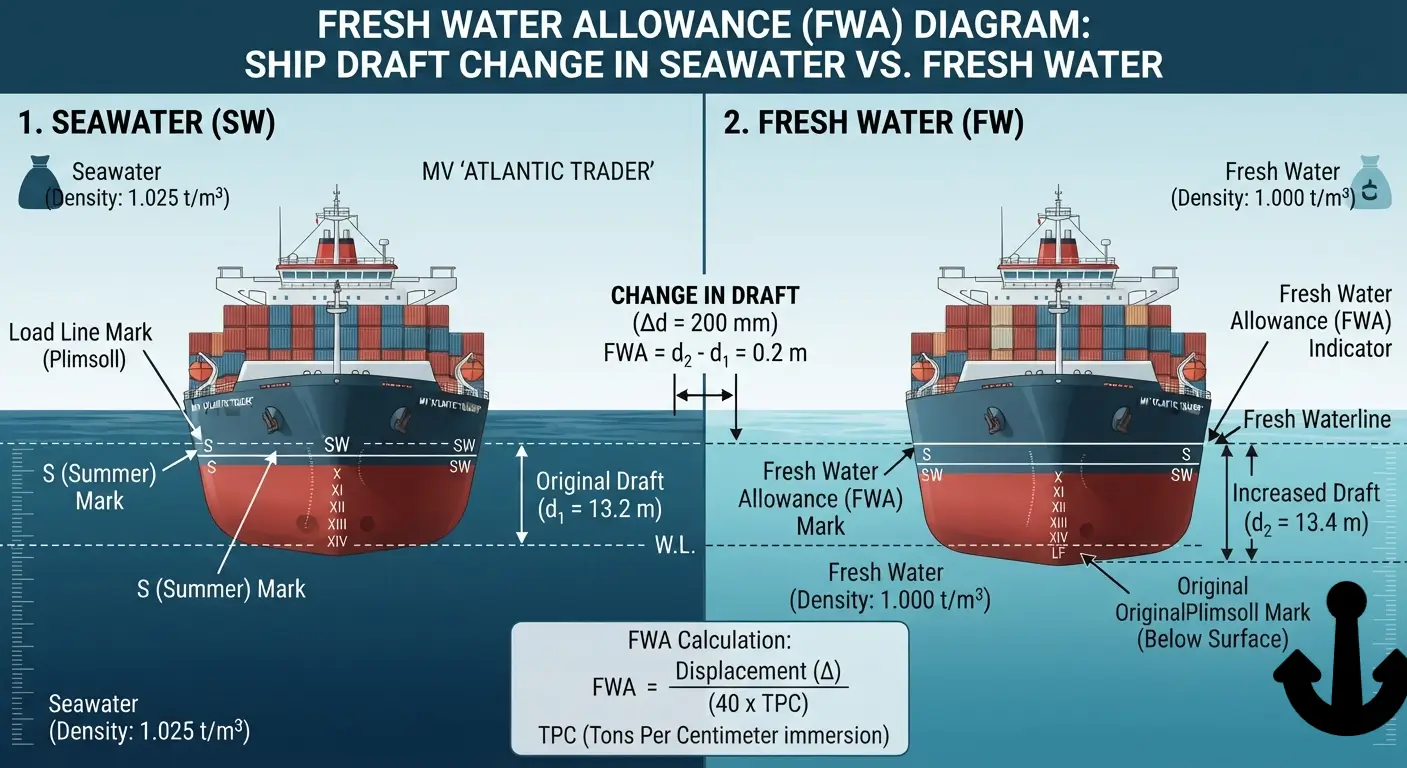
What is fresh water allowance?
Fresh water allowance (FWA) is the increase in a ship's draft when it moves from seawater into fresh water without changing its weight.
Fresh water has a lower density than seawater. The ship therefore has to displace more water to produce the same buoyant force, which causes the ship to sink slightly deeper.
What is the fresh water allowance formula?
A practical hydrostatic form of the calculation is:
$$FWA = \frac{\Delta \left( \frac{\rho_s}{\rho_f}-1 \right)} {TPC}$$
When TPC is expressed in tonnes per centimeter immersion, the result is in centimeters.
Here:
- FWA = fresh water allowance
- Δ = ship displacement in tonnes
- TPC = tonnes per centimeter immersion
- ρs = seawater density
- ρf = fresh-water density
How do you calculate fresh water allowance step by step?
- Find the ship's displacement in tonnes.
- Find the vessel's TPC at the applicable loading condition.
- Determine the seawater density used by the applicable calculation.
- Determine the fresh-water density.
- Calculate the density ratio.
- Apply the FWA formula.
- Convert the result into millimeters, centimeters, or inches as needed.
What is TPC in ship calculations?
TPC means tonnes per centimeter immersion. It is the amount of additional displacement required to increase a ship's mean draft by one centimeter.
TPC is normally obtained from the ship's hydrostatic tables or hydrostatic curves at the relevant draft.
Why is TPC needed to calculate fresh water allowance?
Displacement tells you how much weight the ship must support, but it does not tell you directly how much the draft changes when the displaced volume changes.
TPC provides that missing hydrostatic relationship between a change in displacement and a change in draft.
What water density is used for fresh water allowance?
A common reference density for fresh water is approximately 1000 kg/m³. A commonly used reference density for seawater is approximately 1025 kg/m³.
| Water | Typical Reference Density |
|---|---|
| Fresh water | 1000 kg/m³ |
| Seawater | 1025 kg/m³ |
| Density difference | 25 kg/m³ |
The actual density used for a particular calculation can depend on the applicable regulations, load-line convention, water conditions, and vessel documentation.
Fresh water allowance example
Suppose a vessel has:
- Displacement = 10,000 tonnes
- TPC = 25 tonnes per centimeter
- Seawater density = 1025 kg/m³
- Fresh-water density = 1000 kg/m³
First calculate the density ratio:
$$\frac{1025}{1000}-1 = 0.025$$
Then calculate the fresh water allowance:
$$FWA = \frac{10,000 \times 0.025}{25}$$
$$FWA = 10\ cm$$
The calculated fresh water allowance is therefore 10 cm, or 100 mm, under these assumptions.
What does fresh water allowance mean in practice?
If a vessel moves from seawater into fresh water while maintaining the same weight, its draft increases by the calculated FWA.
The value is particularly important in load-line and cargo-loading calculations because the ship's freeboard and draft depend on the density of the water in which the vessel is floating.
Is fresh water allowance the same as change of draft due to density?
They describe closely related effects, but the calculations are not always identical.
A simple density-ratio relationship can estimate how draft changes when water density changes:
$$T_2 = T_1 \frac{\rho_1}{\rho_2}$$
For a ship-specific fresh water allowance, however, hydrostatic information such as TPC should be used.
Why does a ship sink deeper in fresh water?
Fresh water is less dense than seawater. For the same displaced volume, fresh water produces less buoyant force. The ship therefore has to displace more fresh water to support the same weight.
$$Lower\ Density \rightarrow Greater\ Displaced\ Volume \rightarrow Greater\ Draft$$
How much does a ship's draft increase in fresh water?
There is no single value for every ship. The increase depends on displacement and the ship's hydrostatic properties, particularly TPC.
For this reason, using a generic percentage without the vessel's hydrostatic data can produce an inaccurate result.
Can fresh water allowance be calculated without TPC?
Not accurately for an arbitrary vessel using the standard hydrostatic approach. You need TPC or equivalent waterplane-area information.
This is why ship hydrostatic tables are important for precise draft and load-line calculations.
How do you convert fresh water allowance from centimeters to millimeters?
$$FWA(mm) = FWA(cm) \times 10$$
For example, 10 cm equals 100 mm.
How do you convert fresh water allowance to inches?
$$FWA(in) = FWA(mm) \div 25.4$$
For example, 100 mm is approximately 3.94 inches.
What is the difference between FWA and TPC?
FWA is a draft allowance caused by the difference between fresh water and seawater density. TPC is a hydrostatic property that tells you how much additional displacement is required to change the vessel's mean draft by one centimeter.
Fresh water allowance FAQ
It is the increase in a ship's draft when it moves from seawater to fresh water at the same displacement.
A practical hydrostatic formula is FWA = Δ × (ρs / ρf − 1) ÷ TPC, with compatible units.
1025 kg/m³ is a commonly used reference density for seawater in marine calculations, although the correct value depends on the applicable convention and water conditions.
1000 kg/m³ is a common reference value for fresh water in marine calculations.
The vessel's draft increases when it moves from seawater to lower-density fresh water, assuming the displacement stays the same.