How to Calculate Boat Weight Capacity
Learn how to calculate a boat's usable weight capacity by accounting for passengers, fuel, water, equipment, gear, and other onboard loads. This guide explains the basic formulas and how to avoid common loading mistakes.
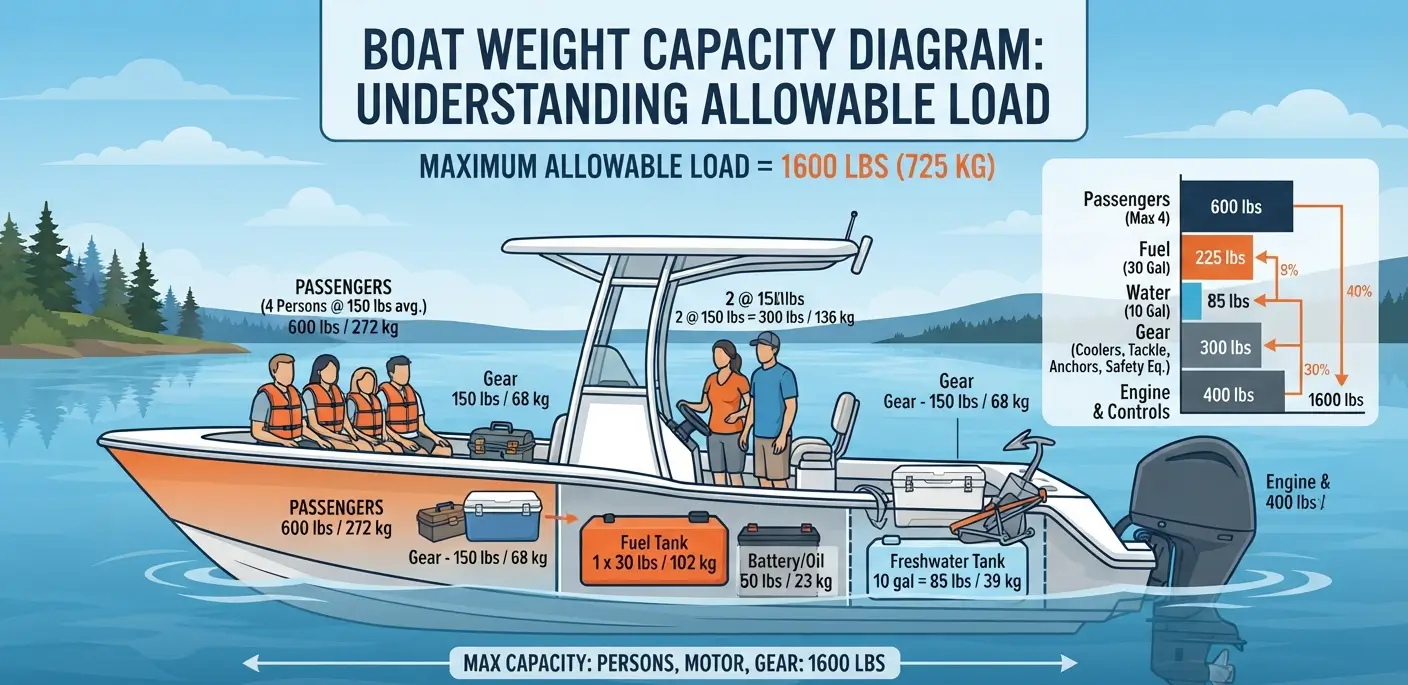
How do you calculate boat weight capacity?
The basic calculation is to determine the maximum permitted loaded weight and then subtract the weight of everything already carried by the boat.
$$Available\ Capacity = Maximum\ Allowed\ Load - Existing\ Onboard\ Weight$$
Existing onboard weight can include passengers, fuel, water, batteries, safety equipment, fishing equipment, coolers, luggage, spare parts, and other gear depending on how the boat's capacity specification is defined.
What is included in a boat's weight capacity?
The exact definition depends on the boat, its manufacturer, and the applicable capacity rules. For practical loading calculations, the total onboard load can include:
- Passengers and crew
- Fuel
- Fresh water
- Portable batteries or additional battery banks
- Fishing and watersports equipment
- Coolers and food
- Luggage and personal gear
- Tools and spare parts
- Portable accessories and equipment
Permanent installed equipment may already be accounted for in the boat's published weight or capacity calculation, so it should not automatically be added a second time.
What is the difference between boat weight capacity and passenger capacity?
Passenger capacity refers to how many people the boat is designed or certified to carry. Weight capacity refers to the total allowable load. They are related, but they are not the same thing.
A boat might have a stated maximum number of people and a maximum combined weight. Both limits may need to be respected.
Passenger count limit and total weight limit are separate constraints.
How do you calculate passenger weight for a boat?
The simplest method is to multiply the number of people by the assumed average passenger weight.
$$Passenger\ Weight = Number\ of\ People \times Average\ Weight$$
For more accurate loading calculations, use the actual weight of each person rather than relying on an average.
How does fuel affect boat weight capacity?
Fuel is part of the boat's loaded weight. Fuel weight therefore needs to be considered when determining how much additional passenger and gear weight remains available.
A useful approximation for gasoline is about 6.0 to 6.3 pounds per US gallon, while diesel is typically heavier. The actual density varies with fuel type and temperature, so the manufacturer's or supplier's specification should be used for precise calculations.
$$Fuel\ Weight = Fuel\ Volume \times Fuel\ Density$$
How does water affect boat weight capacity?
Fresh water weighs approximately 8.34 pounds per US gallon, or approximately 1 kilogram per liter.
Therefore, a large freshwater tank can represent a substantial portion of a small boat's available payload.
$$Water\ Weight \approx Water\ Volume \times 8.34\ lb/gal$$
How do you calculate remaining boat capacity?
Once the weight of passengers, fuel, water, and gear has been calculated, subtract their combined weight from the permitted maximum.
$$Remaining\ Capacity = Maximum\ Capacity - Passengers - Fuel - Water - Gear$$
The result is the approximate amount of additional load that remains under the selected capacity limit.
Boat weight capacity example
Suppose a boat has a maximum allowable loaded weight of 1,500 lb. You have four people weighing 170, 160, 150, and 130 lb. Fuel weighs 150 lb, and equipment weighs 100 lb.
$$Passengers = 170 + 160 + 150 + 130 = 610\ lb$$
$$Total\ Existing\ Load = 610 + 150 + 100 = 860\ lb$$
$$Remaining\ Capacity = 1500 - 860 = 640\ lb$$
Under these assumptions, approximately 640 lb of additional allowable load remains. The actual certified capacity rules for the particular boat should take precedence over a generic calculation.
Does boat dry weight equal boat loading capacity?
No. Dry weight is the weight of the boat in a specified unloaded condition. It does not mean that the boat can carry that same amount again as payload.
Payload or capacity is determined from the boat's design and the applicable limits, not simply by subtracting dry weight from some arbitrary number.
What is the difference between displacement and weight capacity?
Displacement is the total weight supported by the water when the boat is floating in a particular condition. Weight capacity is the allowed load under the boat's specified operating or regulatory limits.
A displacement figure should not automatically be treated as the maximum payload.
How does gear affect boat weight capacity?
Gear can consume a surprising amount of payload, especially on fishing boats and cruising boats. Rods, tackle, anchors, coolers, batteries, tools, spare parts, water toys, diving equipment, and luggage all contribute to total onboard weight.
A good loading calculation treats these items as real weights rather than assuming they are insignificant.
Does where the weight is placed matter?
Yes. Total weight is only one part of loading. The location of the weight can also change trim and stability.
Two loading conditions with the same total weight can behave differently if one places more weight high, forward, aft, or outboard.
$$Moment = Weight \times Distance$$
Can you exceed boat weight capacity if the boat is not full?
The number of people alone does not determine whether the boat is overloaded. You must consider the combined weight of everyone and everything aboard, as well as the applicable capacity limits.
A boat that looks physically spacious can still exceed its permitted weight or stability limits.
How should I calculate boat capacity for a fishing trip?
- Start with the boat's certified or specified maximum load.
- Calculate the weight of all passengers.
- Estimate the fuel load.
- Add water carried aboard.
- Add fishing tackle and equipment.
- Add food, coolers, clothing, and personal gear.
- Subtract all of these weights from the permitted limit.
- Check the boat's passenger and stability requirements separately.
What should I use as the maximum boat weight?
Use the capacity information provided for the specific boat, including the manufacturer's capacity plate, owner's manual, or applicable regulatory documentation. Do not invent a maximum load from hull dimensions alone.
For many boats, the certified capacity information is more important than a theoretical payload estimate.
Can boat weight capacity be calculated from hull dimensions?
You can estimate displacement and buoyancy from hull geometry, but that is not the same as determining the boat's certified maximum loading capacity.
Formal capacity and stability calculations can involve hull form, reserve buoyancy, freeboard, stability characteristics, flooding assumptions, structural limits, and applicable standards.
Boat weight capacity FAQ
There is no reliable universal capacity based only on boat length. The allowable load depends on the specific boat design and its certified capacity information.
Yes. Fuel contributes to the boat's total loaded weight and should be included according to the applicable capacity definition.
Not necessarily. For conservative loading calculations, personal luggage and equipment should be included separately unless the specified capacity convention explicitly includes them.
Buoyancy can help estimate displacement, but it does not by itself establish a certified maximum passenger or payload capacity.
Overloading can reduce freeboard, increase draft, affect trim and stability, worsen handling, and increase the risk of taking water aboard. The exact effects depend on the vessel and loading condition.
A conservative operating margin can be useful because actual passenger weights, fuel levels, gear, weather, and loading position may differ from estimates. The appropriate margin depends on the vessel and the applicable operating requirements.