How to Calculate Boat Displacement
Learn how to calculate boat displacement from displaced water volume and water density. This guide explains the basic displacement formula, freshwater versus seawater, practical examples, and the difference between displacement and boat weight.
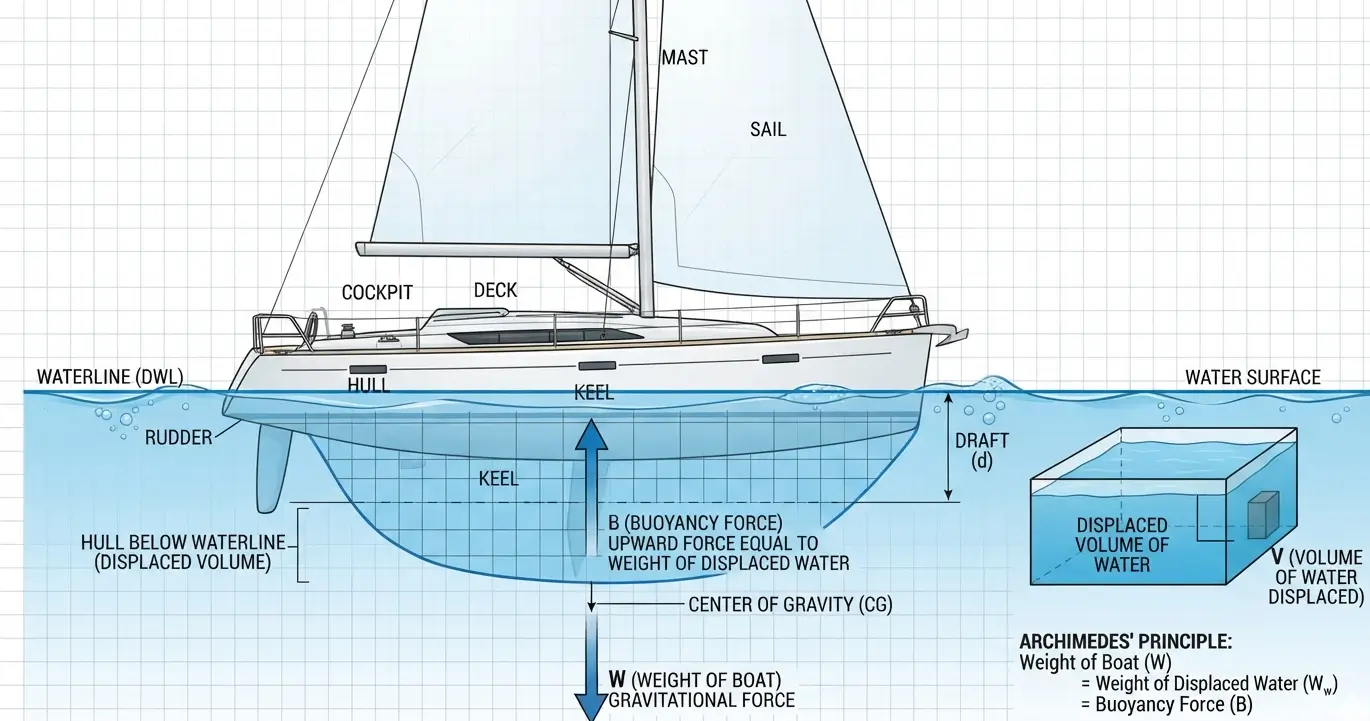
What is boat displacement?
Boat displacement is the amount of water a floating boat pushes aside, expressed as the weight of that displaced water or, depending on the context, the corresponding displaced volume.
In naval architecture, displacement is commonly treated as a weight. A boat floating in equilibrium displaces enough water so that the buoyant force balances the total weight of the vessel.
$$Boat\ Weight = Weight\ of\ Displaced\ Water$$
How do you calculate boat displacement?
The basic calculation requires the volume of water displaced by the submerged part of the hull and the density of the water.
$$Displacement = Volume_{displaced} \times Water\ Density$$
When using SI units, displaced volume is measured in cubic meters and water density in kilograms per cubic meter, giving displacement in kilograms.
$$\Delta = V \times \rho$$
- Δ: Boat displacement by mass.
- V: Submerged displaced volume.
- ρ: Water density.
How do you calculate displaced volume?
For a simple geometric shape, volume can be calculated directly. A real boat hull, however, is not usually a simple rectangular or cylindrical shape, so its underwater volume normally requires hull geometry, hydrostatics, a lines plan, CAD model, or measured dimensions.
For a very simplified rectangular approximation, volume would be:
$$V = Length \times Beam \times Draft$$
This is only a rough geometric approximation because the hull does not normally occupy the entire rectangular block defined by length, beam, and draft.
What is the correct boat displacement formula?
The fundamental relationship is:
$$\boxed{\Delta = \rho V}$$
In practice, the challenge is usually finding the correct submerged volume rather than applying the formula itself.
How do you calculate boat displacement in freshwater?
Freshwater has a density close to 1,000 kg/m³ under normal conditions. Therefore, a vessel displacing 10 m³ of freshwater has a displacement of approximately 10,000 kg.
$$10\ m^3 \times 1000\ kg/m^3 \approx 10,000\ kg$$
The actual density of freshwater varies with temperature and dissolved substances, so precise hydrostatic calculations can use the actual water density for the operating environment.
How do you calculate boat displacement in seawater?
Seawater is denser than freshwater. A common approximate value for seawater is about 1,025 kg/m³, although actual density depends on salinity, temperature, and pressure.
$$Displacement = V \times 1025\ kg/m^3$$
Because seawater is denser, a boat needs to displace slightly less volume to support the same weight than it would in freshwater.
What is the difference between boat displacement and boat weight?
For a floating boat in static equilibrium, the boat's total weight and the weight of the water it displaces are equal.
The terms are therefore closely related, but they describe two sides of the same physical relationship:
| Term | Meaning |
|---|---|
| Boat weight | Total gravitational weight of the vessel and its contents. |
| Displaced volume | Volume of water pushed aside by the submerged hull. |
| Displacement | Weight of the displaced water, equal to boat weight when floating in equilibrium. |
How do you calculate boat displacement in pounds?
If displaced volume is known in cubic feet, displacement can be estimated using water's weight density.
A commonly used approximation is about 62.4 lb per cubic foot for freshwater and about 64 lb per cubic foot for seawater.
$$Displacement_{lb} = Volume_{ft^3} \times Water\ Weight\ Density$$
For example, if a boat displaces 500 cubic feet of seawater:
$$500 \times 64 \approx 32,000\ lb$$
How do you calculate boat displacement in tons?
Once displacement has been calculated as a mass or weight, it can be converted into the desired tonnage unit.
$$Metric\ Tonnes = \frac{Kilograms}{1000}$$
$$Short\ Tons = \frac{Pounds}{2000}$$
Be careful because "ton" can mean different units. Metric tonnes, short tons, and long tons are not the same.
Can you calculate boat displacement from length, beam, and draft?
You can make a rough estimate, but length × beam × draft does not equal the actual underwater volume of most boat hulls.
A hull-form coefficient can be introduced for a simplified displacement estimate:
$$V \approx L \times B \times T \times C$$
$$\Delta \approx \rho LBT C$$
Here C represents an approximate hull-volume coefficient. The appropriate coefficient varies substantially between hull types, so this method is an estimate rather than a substitute for actual hydrostatic data.
What is the block coefficient of a boat?
The block coefficient, often written as CB, compares the underwater volume of a hull with the volume of the rectangular block defined by its length, beam, and draft.
$$C_B = \frac{\nabla} {L_{pp}BT}$$
A lower block coefficient generally describes a finer hull, while a higher value represents a fuller hull form. The actual definition and reference length used depend on the naval-architecture convention.
How does draft affect boat displacement?
Increasing draft generally increases the submerged volume of the hull and therefore increases displacement, assuming the vessel's hull geometry is fixed.
This is why adding fuel, passengers, water, equipment, or cargo causes a floating boat to settle deeper into the water.
$$More\ Weight \rightarrow More\ Displacement \rightarrow Greater\ Draft$$
How does loading affect boat displacement?
Every additional load placed aboard a floating vessel adds weight. The boat responds by displacing additional water until the buoyant force balances the increased weight.
If 500 kg of passengers, fuel, and equipment are added, the boat's displacement increases by approximately 500 kg in a floating equilibrium condition.
Does seawater change a boat's displacement?
The boat's actual mass does not change simply because it moves from freshwater to seawater. However, the density of the surrounding water changes, which changes the submerged volume required to support the same weight.
$$V = \frac{\Delta}{\rho}$$
Since seawater is denser, the same boat weight can be supported by a slightly smaller displaced volume than in freshwater.
How can you measure boat displacement?
There are several approaches depending on the required accuracy.
- Use the manufacturer's published displacement figure if available.
- Use hydrostatic data to determine displaced volume at a known draft.
- Use a lines plan or 3D hull model to calculate underwater volume.
- Measure draft and use a validated hydrostatic model for the hull.
- For highly accurate work, use appropriate weighing or displacement measurement procedures under controlled conditions.
What is lightship displacement?
Lightship displacement refers to the vessel's displacement in a defined light condition. The exact items included in that condition depend on the applicable definition or documentation.
It should not automatically be assumed to include all crew, consumables, stores, cargo, or operating loads.
What is full-load displacement?
Full-load displacement is the displacement of the vessel under a specified fully loaded operating condition. The exact loading condition must be defined because "full load" can mean different things for different vessel types and standards.
What is the difference between displacement and gross tonnage?
Displacement is a measure of the vessel's weight or displaced water volume. Gross tonnage is a measurement based on enclosed internal volume under a formal tonnage convention. They are fundamentally different quantities and should not be treated as interchangeable.
Boat displacement FAQ
Multiply the volume of water displaced by the submerged hull by the density of the water: Displacement = Displaced Volume × Water Density.
A cubic meter of seawater is commonly approximated at about 1,025 kg, although actual seawater density varies with temperature, salinity, and pressure.
A cubic meter of freshwater is approximately 1,000 kg under ordinary conditions, with the exact density depending on temperature and water composition.
Not necessarily. Displacement refers to the vessel's loaded floating condition, while dry weight refers to a particular unloaded weight condition.
Yes. In a floating equilibrium condition, additional passenger weight causes the boat to displace additional water.
Only as a rough approximation. Real hulls are not rectangular, so a hull-form or volume coefficient is needed for a meaningful estimate.