The maritime industry loves its classifications, and few distinctions generate as much discussion as the line between a yacht and a superyacht. While there is no single legal definition that applies worldwide, the difference between a yacht and a superyacht is widely agreed upon within the industry. It comes down to length, luxury standards, crew, and the regulatory frameworks that govern each class of vessel.
The Size Threshold
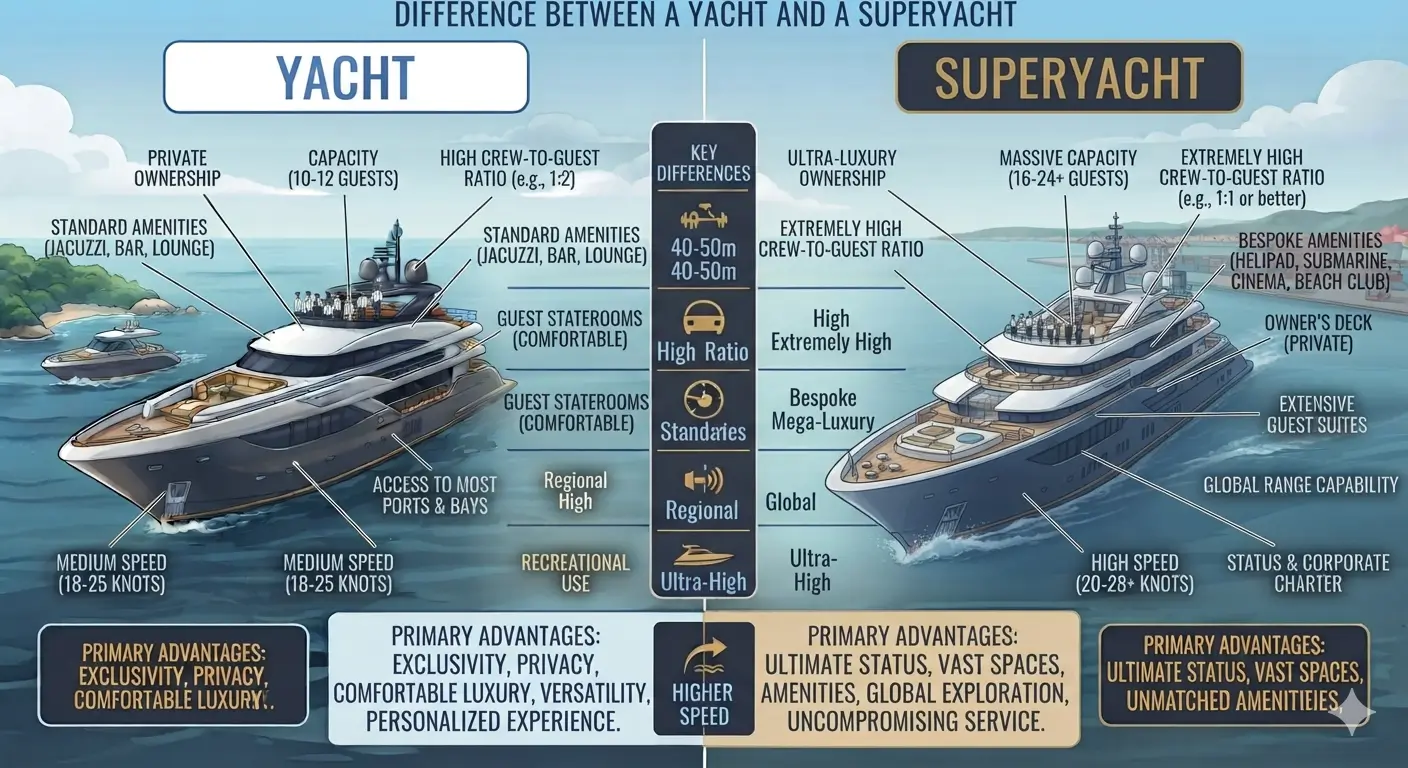
The most commonly cited dividing line is 24 meters (approximately 80 feet). Vessels at or above this length are generally classified as superyachts by brokers, shipyards, classification societies, and maritime media. Some sources place the threshold at 30 meters (100 feet), but 24 meters is the standard used by most industry databases. Below this length, a vessel is simply referred to as a yacht — no matter how luxurious it may be.
Beyond Length: The Megayacht Category
Within the superyacht world, there is an additional tier. Vessels exceeding 60 meters (approximately 200 feet) are often called megayachts, and those above 100 meters are sometimes referred to as gigayachts. These are the headline-grabbing vessels that cost hundreds of millions of dollars and take years to build. As of 2026, there are roughly 1,000 megayachts in operation worldwide.
Luxury and Fit-Out Standards
A standard yacht offers comfortable accommodation and solid build quality, but a superyacht takes the concept of onboard luxury to an entirely different level:
- Custom interior design by world-renowned architects and designers
- Dedicated beach clubs, spas, and cinema rooms
- Helipads, submarines, and custom tenders
- Zero-speed stabilisation for comfort at anchor
- Bespoke technology systems controlling every aspect of the vessel
The interiors of superyachts are frequently compared to boutique hotels or penthouse apartments, with no expense spared on materials, craftsmanship, and custom details.
Professional Crew
While a 40-foot yacht might be owner-operated or require just one hired captain, a superyacht demands a full-time professional crew. A 30-meter superyacht might carry 4 to 6 crew members, while a 60-meter megayacht could have 15 to 20. The largest vessels in the world employ crews of 50 or more, including engineers, chefs, deckhands, stewardesses, security personnel, and a dedicated captain with an unlimited master's certificate.
Regulatory Differences
Once a vessel crosses the 24-meter threshold, it falls under more stringent regulatory codes. In many flag states, superyachts must comply with the Large Yacht Code (LY3) or the Passenger Yacht Code (PYC), which impose strict requirements on safety equipment, structural standards, crew certification, and operational procedures. A standard yacht below 24 meters is subject to lighter recreational craft regulations.
Cost Gap
The financial leap from yacht to superyacht is dramatic. A well-equipped 50-foot yacht might cost $800,000 to $2 million. A 30-meter superyacht starts at approximately $5 million to $10 million and climbs steeply from there. Custom-built superyachts of 50 meters and above regularly sell for $30 million to $80 million, with the largest exceeding $500 million. Annual operating costs — crew, fuel, insurance, maintenance, and berthing — typically run at 10 percent of the build price.
In Summary
The jump from yacht to superyacht is not merely about adding a few extra meters. It represents an entirely different category of vessel, with bespoke construction, full-time crew, luxury amenities that rival five-star resorts, and operating costs that match. The 24-meter mark is more than a number — it is the gateway to a rarefied world of maritime excellence.