The words "yacht" and "sailboat" are often confused, partly because some yachts are indeed powered by sails. However, the difference between a yacht and a sailboat lies in size, luxury, propulsion systems, and the overall experience each vessel delivers. Here is a clear breakdown of what sets them apart.
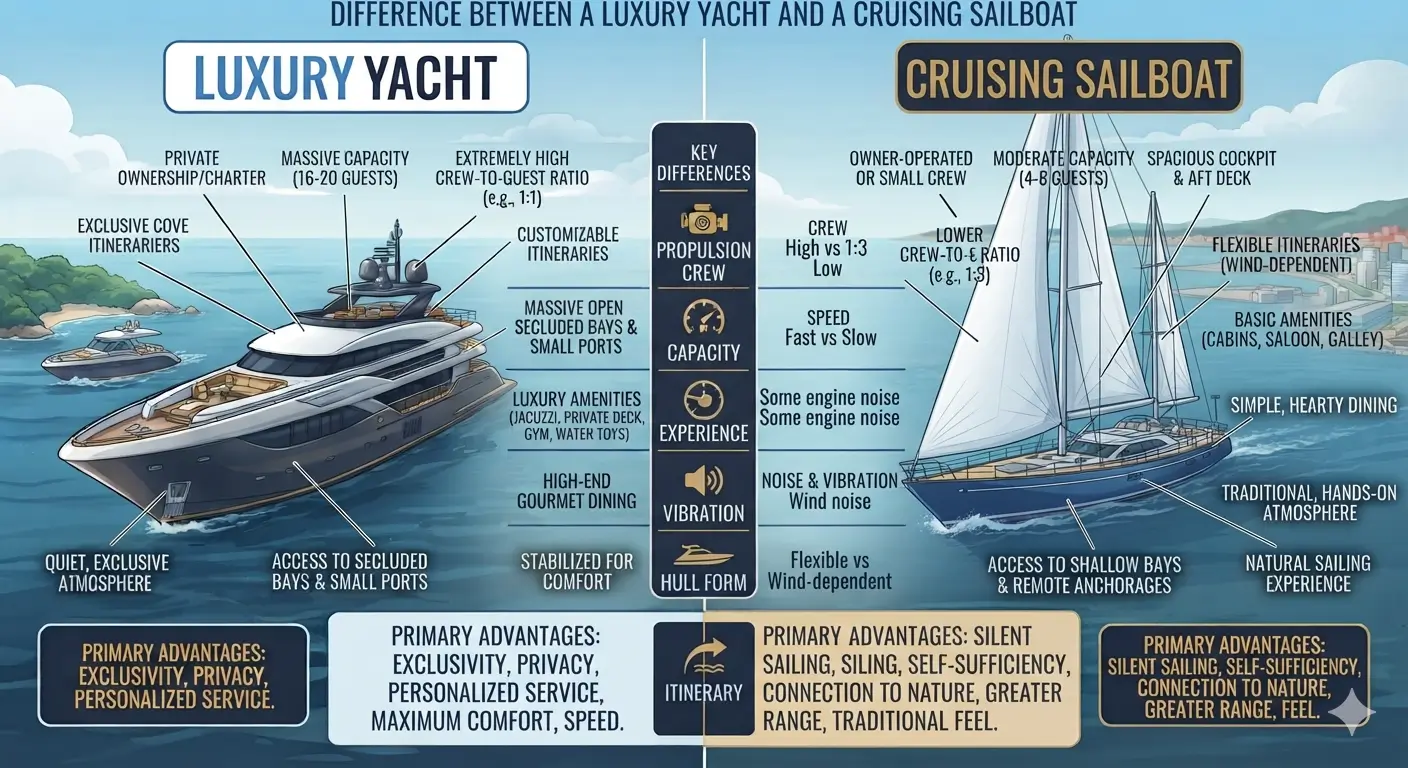
Propulsion: Sails vs. Engines
A sailboat is defined by its primary means of propulsion — wind power via sails. While most modern sailboats have a small auxiliary engine for manoeuvring in and out of harbour, the sails are the main source of motion. Yachts, on the other hand, are predominantly motor-powered. They rely on powerful diesel or turbine engines to achieve cruising speeds between 10 and 30 knots. That said, sailing yachts do exist — large, luxurious vessels that use sails as their primary propulsion. These are often referred to as "sailing superyachts" and represent a niche but growing segment of the market.
Size Matters
Sailboats come in a wide range of sizes, from small dinghies under 15 feet to offshore cruisers of 50 feet or more. The term "yacht" is generally reserved for vessels starting at about 33 feet (10 meters), with most industry professionals applying the label to boats of 40 feet and above. When a sailing vessel crosses into superyacht territory — 24 meters (80 feet) or more — it is typically referred to as a sailing yacht rather than simply a sailboat.
Comfort and Accommodation
A typical sailboat prioritises sailing performance and seaworthiness. Cabins are compact and efficient, with basic galley facilities and heads (bathrooms). Space is allocated to rigging, sail storage, and deck hardware. A yacht, whether motor or sail, is designed for comfort and hospitality:
- Spacious staterooms with king-size beds and climate control
- Full-beam master suites with walk-in wardrobes
- Professional galley kitchens rivalling high-end restaurants
- Multiple lounging areas, sun decks, and entertainment zones
Crew Requirements
Most recreational sailboats can be operated by a single person or a small family crew — in fact, solo circumnavigation is one of sailing's great traditions. Yachts above 60 feet almost always require a professional crew, including a licensed captain, engineer, chef, and service staff. The ratio of crew to guests on a luxury yacht can be as high as one-to-one.
Cost Comparison
Entry-level sailboats can be purchased for as little as $10,000 to $50,000 for a used coastal cruiser. A new production sailboat in the 40-foot range typically costs $200,000 to $500,000. Yachts start well above this mark, with even modest motor yachts priced from $500,000 upward. Superyachts regularly command prices in the tens of millions, and the annual operating costs scale accordingly.
The Sailing Yacht Overlap
It is worth noting that the line between sailboat and yacht is not always clear-cut. A beautifully appointed 50-foot cruising sailboat with premium interiors might fairly be called a "sailing yacht." The distinction is ultimately a matter of size, luxury level, and intended use. If the vessel prioritises grand living spaces and onboard hospitality over pure sailing performance, it leans toward the yacht end of the spectrum — regardless of how it is propelled.