Choosing between a yacht experience and a cruise holiday is one of the first decisions luxury travellers face when planning a maritime getaway. While both put you on the water, the difference between a yacht and a cruise is enormous — spanning everything from itinerary control to dining, privacy, and the overall pace of your holiday.
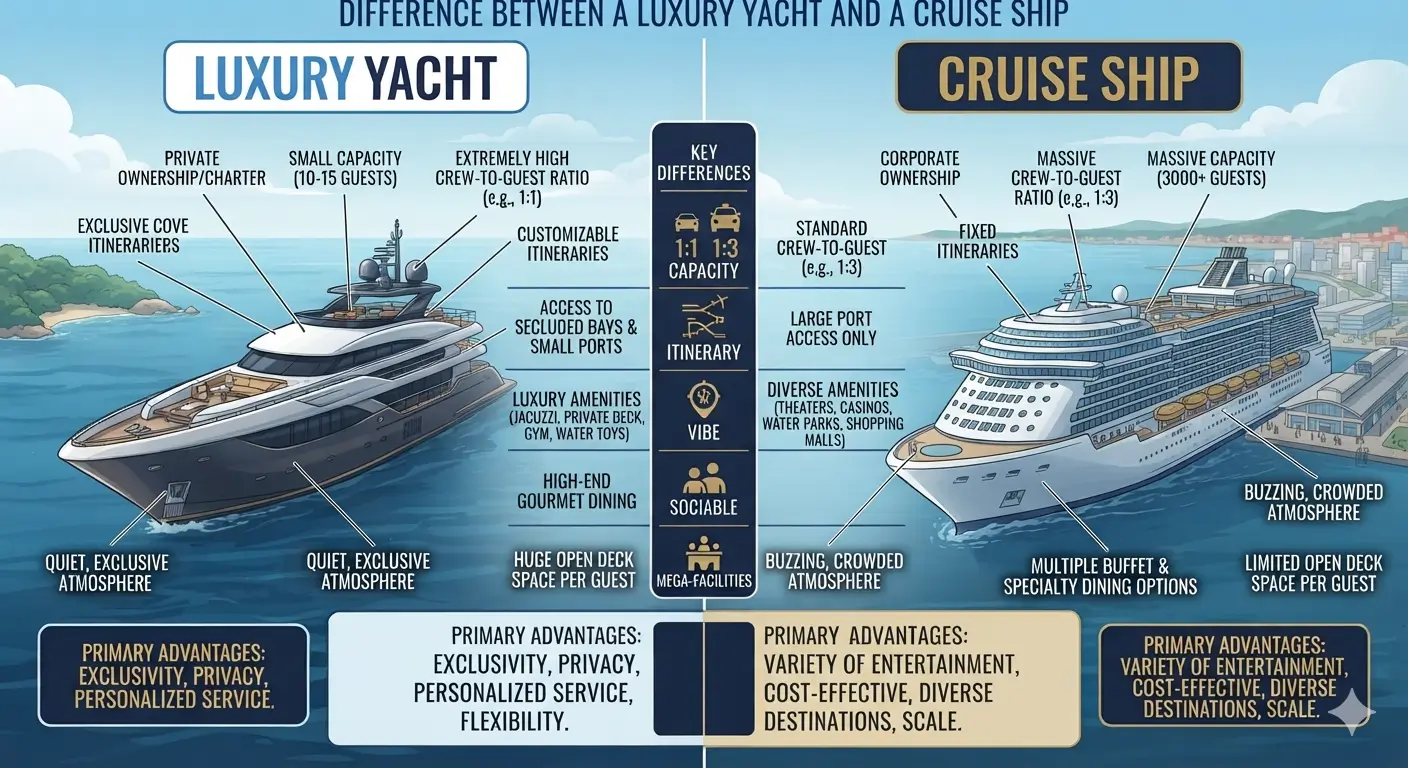
Private vs. Shared Experience
The most fundamental difference is one of exclusivity. A yacht — whether you own it or charter it — is entirely yours for the duration of the trip. You decide who is on board, what you eat, where you go, and when you go there. A cruise is, by definition, a shared experience. You are one of hundreds or thousands of passengers following the same schedule, eating in the same restaurants, and visiting the same ports at the same times.
Itinerary Freedom
Cruises operate on fixed routes with predetermined ports of call and strict departure windows. If the ship leaves at 5pm, you need to be back on board — no exceptions. On a yacht, you write your own itinerary in real time:
- Stay an extra day at a beautiful anchorage if you are enjoying it
- Skip a crowded port and head to a quieter bay instead
- Change your destination entirely based on weather, mood, or local recommendations
- Access shallow bays and remote islands that large cruise ships simply cannot reach
This freedom is consistently rated as the single most valuable aspect of the yachting experience by charter guests.
Dining and Service
Cruise ships offer an impressive variety of dining options — sometimes 10 or more restaurants on a single ship — along with buffets, cafés, and room service. However, the experience is standardised. Menus rotate on a schedule, and peak dining hours mean crowded venues. On a yacht, your private chef prepares every meal specifically for you and your guests. Dietary requirements, personal preferences, and even spontaneous cravings are accommodated without question. Want a beachside barbecue on a deserted shore? Your crew will make it happen.
Pace of Travel
A cruise holiday is structured and activity-driven. Days are filled with scheduled entertainment, excursions, shows, and organised events. This can be wonderful if you enjoy a busy, social atmosphere. A yacht holiday moves at whatever pace you set. Sleep in until noon, swim before breakfast, spend the afternoon snorkelling, or simply read a book on the sun deck in complete silence. There is no daily programme, no announcement over a PA system, and no obligation to be anywhere at any particular time.
Destinations and Access
Cruise ships are restricted to deep-water ports with the infrastructure to handle large vessels. This means you will almost always dock at well-known, tourist-heavy destinations. Yachts draw far less water and can access an entirely different world of destinations — hidden coves, private beaches, and small fishing villages that are completely inaccessible to cruise liners. In popular sailing grounds like Croatia, the Greek islands, or the British Virgin Islands, the most beautiful spots are often only reachable by smaller vessels.
Cost Considerations
Cruises are one of the most cost-effective holiday options available. A week in a standard cabin can cost under $1,000 per person, and even luxury suites on premium cruise lines rarely exceed $15,000. A yacht charter is a significantly larger investment — starting at around $15,000 to $50,000 per week for a smaller crewed yacht and reaching $500,000 or more for the world's most prestigious superyachts. However, when you divide the charter cost by the number of guests and compare it to the very top tier of cruise suites, the gap narrows more than most people expect.
The Verdict
A cruise holiday and a yacht holiday are both wonderful ways to spend time on the water, but they cater to fundamentally different desires. If you want variety, social energy, and value for money, a cruise is a fantastic choice. If you crave privacy, freedom, bespoke service, and the ability to explore off-the-beaten-path destinations, a yacht experience is in a class of its own. Many seasoned travellers ultimately discover that the two are not competing options at all — they are entirely different categories of holiday.