Both yachts and cruise ships promise a life on the water, but the experiences they offer could not be more different. Understanding the difference between a yacht and a cruise ship is essential for anyone deciding how they want to explore the world's oceans — whether as a private owner, a charter guest, or a holidaymaker choosing between two very different styles of travel.
Scale and Passenger Capacity
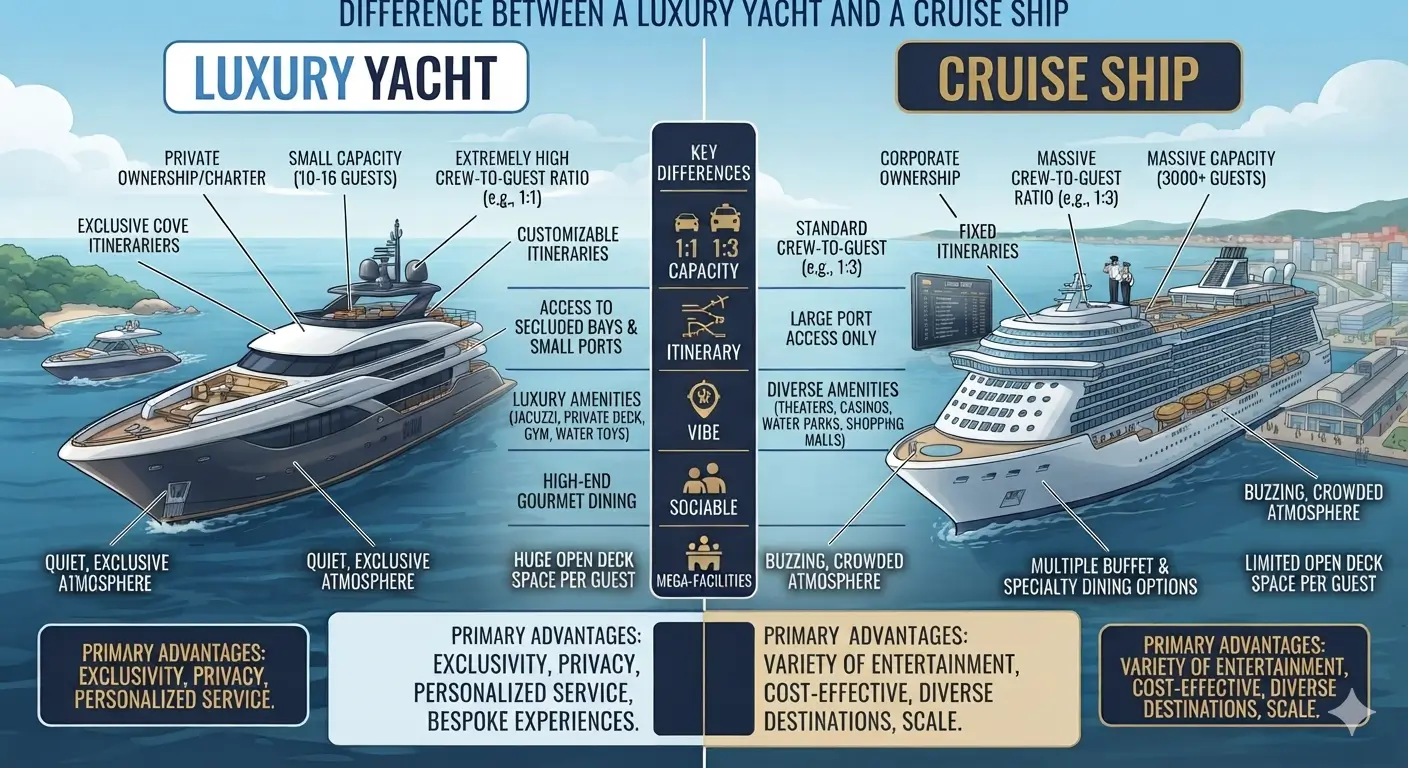
The most striking difference is sheer size. Modern cruise ships are floating cities. The largest can exceed 360 meters (1,180 feet) in length and carry over 6,000 passengers plus 2,000 crew. Even the world's biggest superyachts rarely surpass 180 meters and are designed for a handful of guests — typically 12 to 36 people. A yacht is intimate; a cruise ship is a mass-market operation.
Privacy and Exclusivity
This is where yachts truly shine. On a yacht, you are not sharing a pool with thousands of strangers or queuing for a buffet. The entire vessel, its crew, and its itinerary are yours. Every meal is prepared to your preferences, every anchorage is chosen for your enjoyment, and every moment is private. A cruise ship, by its very nature, is a shared public experience — communal dining rooms, scheduled entertainment, and set departure times at each port of call.
Itinerary Flexibility
Cruise ships follow fixed routes determined months or years in advance. You board at port A, stop at ports B, C, and D on specific dates, and disembark at port E. A yacht offers complete freedom of movement. Want to extend your stay at a secluded cove in Greece? Done. Fancy skipping a busy port and heading to a remote island instead? Your captain adjusts the course on the spot. This flexibility is one of the most valued aspects of yacht travel.
Onboard Experience
Cruise ships compensate for their lack of privacy with an enormous range of onboard facilities:
- Multiple restaurants, bars, and nightclubs
- Broadway-style theatres and cinemas
- Water parks, rock-climbing walls, and skating rinks
- Shopping arcades, casinos, and spas
A yacht cannot match this volume of amenities, but it delivers a curated, bespoke experience. Instead of a crowded pool deck, you have a private jacuzzi. Instead of a buffet, your personal chef prepares a five-course dinner. Instead of a generic shore excursion, your crew arranges a private guided tour. Quality replaces quantity at every turn.
Crew-to-Guest Ratio
On a luxury cruise line, the crew-to-guest ratio is typically around 1:2 — one crew member for every two passengers. On a superyacht, the ratio can be 1:1 or even higher, meaning there is one dedicated crew member for every single guest on board. This translates directly into the level of personalised attention and service you receive.
Cost Comparison
A week-long cruise in a standard cabin can cost as little as $500 to $2,000 per person. A luxury cruise suite might run $5,000 to $15,000 per person per week. Chartering a superyacht, on the other hand, starts at approximately $50,000 per week for a smaller vessel and can exceed $1 million per week for the most prestigious superyachts — plus expenses such as fuel, food, and docking fees. Owning a yacht is an entirely separate financial conversation, with build costs in the millions and annual running costs to match.
Which Is Right for You?
The choice ultimately depends on what you value most. If you want variety, entertainment, social interaction, and a straightforward, all-inclusive holiday, a cruise ship is an excellent option. If you prize privacy, flexibility, personalised service, and exclusivity, a yacht — whether owned or chartered — delivers an experience that no cruise ship can replicate.