When shopping for a luxury vessel, the debate between a traditional monohull yacht and a catamaran comes up frequently. The difference between a yacht and a catamaran is rooted in hull design, which has cascading effects on stability, interior space, performance, and overall onboard experience. Here is everything you need to know.
Hull Design: One vs. Two
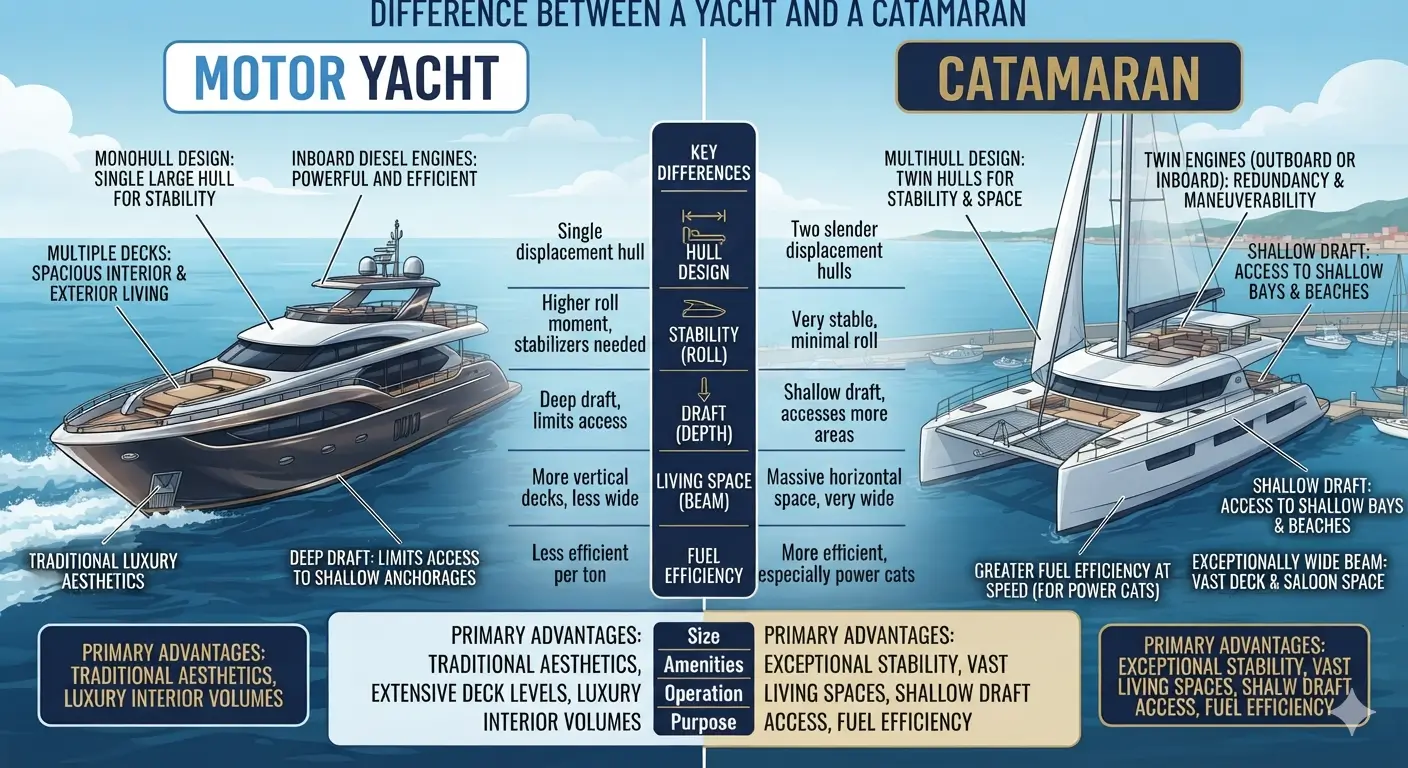
The fundamental difference is structural. A traditional yacht — whether motor or sail — has a single hull (monohull). A catamaran has two parallel hulls connected by a bridging structure called the bridge deck. This twin-hull design is what gives catamarans their distinctive wide-beam profile and their unique set of advantages and trade-offs.
Stability and Comfort
Catamarans are significantly more stable than monohull yachts, particularly at anchor and in moderate seas. The wide stance created by two hulls dramatically reduces rolling motion, which makes catamarans a popular choice for guests who are prone to seasickness. Monohull yachts, while perfectly seaworthy, heel (lean) under sail and roll more noticeably in beam seas. Modern superyachts counter this with zero-speed stabilisers, but these systems add substantial cost and mechanical complexity.
Interior Space
For any given length, a catamaran offers significantly more usable interior volume than a monohull. The wide beam provides:
- Expansive saloon and dining areas at bridge-deck level
- Separate cabins in each hull, offering privacy between port and starboard quarters
- Large aft cockpit areas ideal for outdoor entertaining
- Shallow draught, allowing access to anchorages that deep-keeled monohulls cannot reach
A 50-foot catamaran can offer living space comparable to a 60- or 65-foot monohull yacht. This space advantage is one of the catamaran's strongest selling points.
Performance and Handling
In terms of speed, catamarans and monohull yachts are broadly comparable in the motor-vessel category. Sailing catamarans, however, can be notably faster than monohull sailboats of similar length because they do not need to push a heavy keel through the water. On the downside, catamarans have a wider turning radius and can be more difficult to manoeuvre in tight marina berths. Monohull yachts, with their deeper keels and narrower profiles, are generally more agile in confined spaces.
Marina Access and Berthing
One practical consideration that many first-time buyers overlook is berthing cost and availability. Marina fees are typically calculated by the vessel's length, but some marinas charge based on beam (width) as well. Because catamarans are substantially wider than monohulls, they may require a wider berth or even a dedicated catamaran slip. In popular Mediterranean marinas, wide berths can be scarce and expensive. Monohulls have a clear advantage here, fitting into standard marina spaces with ease.
Seakeeping in Heavy Weather
While catamarans excel in mild to moderate conditions, monohull yachts are often considered superior in heavy weather seakeeping. A well-designed monohull with a deep keel and ballast has a strong natural tendency to right itself after a knockdown. Catamarans, while extremely unlikely to capsize under normal conditions, do not have this self-righting characteristic. For serious blue-water ocean crossings, many experienced sailors still prefer the monohull's proven heavy-weather pedigree.
Which Should You Choose?
The decision depends on your priorities. If you value stability, space, and shallow-water access, a catamaran is hard to beat. If you prefer traditional handling, easier berthing, and proven heavy-weather performance, a monohull yacht remains the gold standard. Increasingly, the luxury market is embracing both — with catamaran superyachts now being built at lengths exceeding 30 meters, offering the best of both worlds to those willing to invest.