How We Verified the Accuracy of This Calculator
To ensure this calculator delivers precise, trustworthy results for yacht designers, sailors, and prospective
boat buyers, we benchmarked and verified our calculation engine against Ted Brewer's original Motion Comfort
Ratio (MCR) formula using three distinct real-world sailboat classes:
| Sailboat Model & Category |
Specifications (Disp, LOA, LWL, Beam) |
Calculated MCR |
Category Bracket |
Real-World Verification |
Catalina 34
(Modern Production Cruiser) |
11,950 lb / 34.5' LOA / 29.83' LWL / 11.75' Beam |
22.04 |
20–30 (Moderate) |
Verified. Light-to-moderate displacement ratio typical of agile coastal production sailboats. |
Pacific Seacraft 37
(Classic Bluewater Cruiser) |
16,200 lb / 36.83' LOA / 27.75' LWL / 10.83' Beam |
34.13 |
30–40 (Higher) |
Verified. Moderate-to-heavy displacement ratio designed for comfortable offshore ocean passages.
|
Westsail 32
(Heavy Traditional Cruiser) |
19,500 lb / 32.0' LOA / 27.5' LWL / 11.0' Beam |
42.51 |
40–50 (High) |
Verified. Heavy double-ended displacement hull providing high motion damping in severe sea states.
|
All metric conversions (kilograms to pounds and meters to feet) utilize exact physical conversion factors (1
kg = 2.2046226 lb, 1 m = 3.2808399 ft) prior to applying Brewer's mathematical equation.
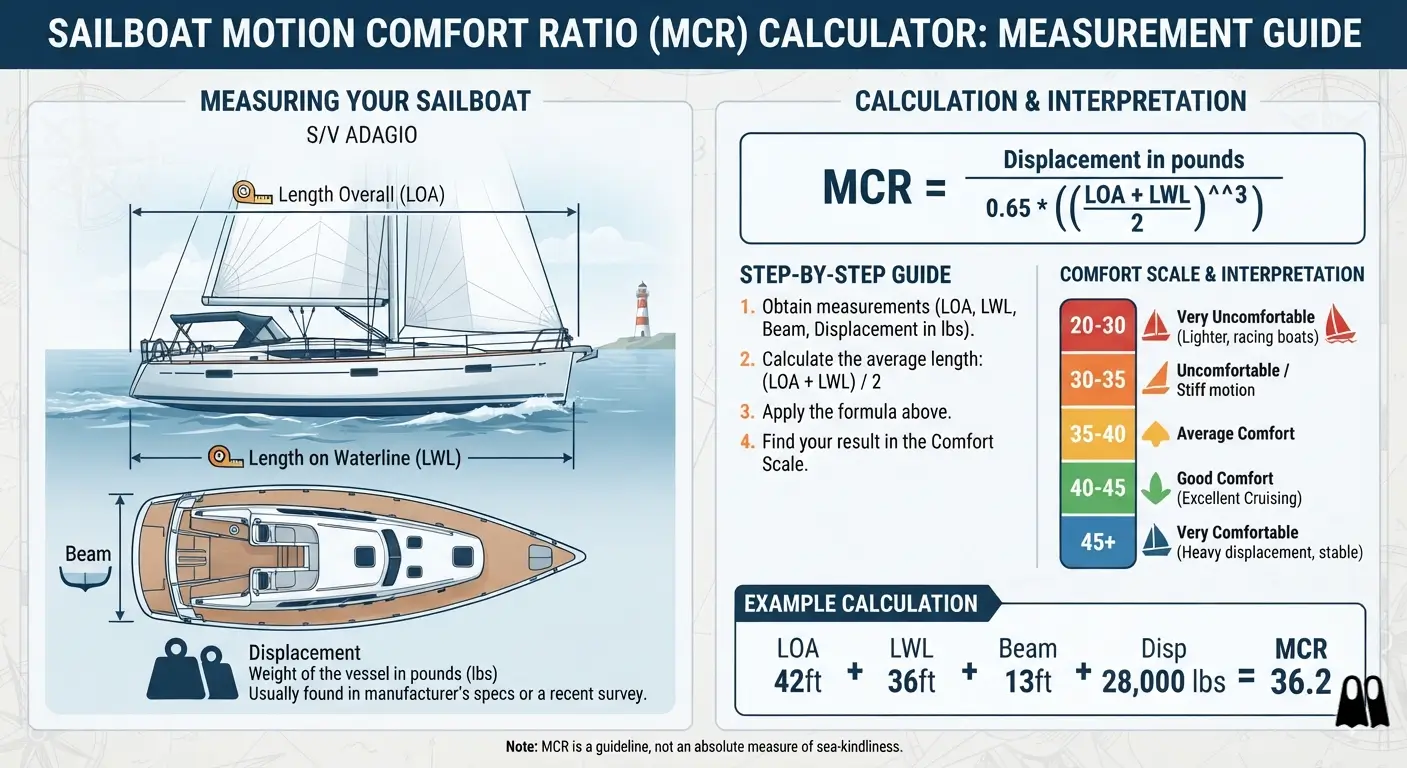
What Is the Sailboat Motion Comfort Ratio?
The Motion Comfort Ratio (MCR) is a traditional yacht-design comparison metric used to estimate how a
sailboat is likely to respond in waves. It combines displacement with the boat's waterline length, overall
length, and beam.
In general, a higher MCR indicates a heavier boat relative to its size and a tendency toward slower, less
abrupt motion. A lower MCR indicates a lighter boat relative to its dimensions and generally livelier motion.
MCR should be treated as a comparative guideline, not as a complete prediction of comfort, stability,
seaworthiness, or actual motion in every sea state. Hull shape, center of gravity, ballast, stability
characteristics, wave direction, wave period, loading, and many other factors also affect how a boat feels at
sea.
What Data Do You Need?
The basic calculator needs four specifications that are normally available in a sailboat's specifications:
- Displacement: the boat's weight, ideally the loaded cruising displacement you want to
evaluate.
- LOA: Length Overall.
- LWL: Length at the waterline.
- Beam: the boat's maximum beam.
You can enter metric or imperial measurements. The calculator converts them internally to the units used by
the traditional equation.
Motion Comfort Ratio Formula
The traditional Brewer-style formula is:
MCR = Displacement ÷ [0.65 × (0.7 × LWL + 0.3 × LOA) × Beam4/3]
Step 1 — Calculate the effective length
Effective Length = 0.7 × LWL + 0.3 × LOA
Step 2 — Calculate Beam4/3
Beam4/3 = Beam × Beam1/3
Step 3 — Calculate MCR
Divide displacement by the complete denominator from the equation above.
Motion Comfort Ratio Calculation Example
Consider a sailboat with:
| Specification |
Example value |
| Displacement |
12,000 lb |
| LOA |
34 ft |
| LWL |
27 ft |
| Beam |
11 ft |
1. Effective length
0.7 × 27 + 0.3 × 34 = 29.1 ft
2. Beam4/3
114/3 ≈ 24.39
3. MCR
12,000 ÷ [0.65 × 29.1 × 24.39] ≈ 26.0
This gives an MCR of approximately 26.0. The value can then be compared with other boats
while remembering that MCR is only a simplified comparative indicator.
How to Interpret the Result
There is no universal boundary where a boat suddenly becomes comfortable or uncomfortable. The following
ranges are best used as broad comparison guides:
| MCR |
General interpretation |
| Below 20 |
Light displacement relative to size; typically livelier motion. |
| 20–30 |
Moderate range; many cruising boats fall around this area. |
| 30–40 |
Higher displacement relative to dimensions; generally slower motion. |
| 40–50 |
Heavy cruising characteristics and potentially more deliberate motion. |
| Above 50 |
Very heavy displacement relative to the measured dimensions. |
These categories should not be treated as engineering limits. They are useful when comparing boats,
especially boats of similar size and type.
Advanced Calculator: What Does It Add?
The advanced calculator keeps the same MCR equation but adds context around it. This is useful when you are
comparing two sailboats instead of checking only one.
Displacement-to-Length Ratio (D/L)
D/L = (Displacement ÷ 2240) ÷ (0.01 × LWL)3
D/L helps describe how heavy a boat is relative to its waterline length.
Beam-to-LWL Ratio
Beam/LWL % = (Beam ÷ LWL) × 100
This gives a simple measure of the boat's beam relative to its waterline length.
Comparing Two Boats
For Boat A and Boat B, the advanced calculator shows both MCR values and calculates the absolute and
percentage difference.
MCR difference = MCR A − MCR B
MCR difference % = [(MCR A − MCR B) ÷ MCR B] × 100
A higher MCR does not mean a boat is a specific percentage “more comfortable.” The percentage is simply a
mathematical comparison between the two MCR values.
Worked Advanced Example
Suppose Boat A has:
- 12,000 lb displacement
- 34 ft LOA
- 27 ft LWL
- 11 ft beam
And Boat B has:
- 9,000 lb displacement
- 32 ft LOA
- 25 ft LWL
- 10.5 ft beam
The advanced calculator calculates the MCR for both boats and then shows which boat has the higher value. It
also reports each boat's D/L ratio and beam-to-LWL percentage so the numbers can be viewed in context.
For a meaningful comparison, use specifications measured in a comparable way. A manufacturer's lightship
displacement and another boat's fully loaded cruising displacement can produce a misleading comparison.
Metric and Imperial Unit Conversions
| Conversion |
Formula |
| kg → lb |
kg × 2.2046226218 |
| lb → kg |
lb × 0.45359237 |
| m → ft |
m × 3.280839895 |
| ft → m |
ft × 0.3048 |
The calculator converts all inputs to pounds and feet before applying the traditional MCR equation so the
result stays consistent regardless of the units the visitor enters.
What a Motion Comfort Ratio Does Not Tell You
MCR is not a complete seakeeping model. It does not directly calculate:
- roll angle in degrees
- pitch angle in degrees
- wave height tolerance
- capsize or stability angle
- natural roll period
- actual human seasickness risk
- survivability in a particular storm
Those questions require additional boat data and, depending on the purpose, more detailed naval-architecture
or stability calculations.
Frequently Asked Questions
What is a good Motion Comfort Ratio for a sailboat?
There is no single “good” value for every sailor or every boat. A higher value generally corresponds to a
heavier boat with slower motion, while a lower value generally corresponds to a lighter, livelier boat.
Should I use empty or loaded displacement?
For cruising comfort comparisons, a loaded cruising displacement is often more representative of how the boat
will actually be used. The key is to compare boats using comparable displacement definitions.
Why does the calculator need both LOA and LWL?
The traditional formula combines both lengths into an effective length: 0.7 × LWL + 0.3 × LOA.
Can I compare two boats with the advanced calculator?
Yes. Enter comparable specifications for Boat A and Boat B to see both MCR values and the difference between
them.
Is a higher MCR always more comfortable?
No. It is better to say that a higher MCR generally suggests a heavier boat and potentially slower motion.
Actual comfort also depends on hull form, loading, stability, sea conditions, and the motion characteristics
of the individual design.