Understanding Rig Geometry & Performance
Whether you are optimizing a rig for PHRF racing, shopping for a new cruiser, or verifying sailmaker quotes, understanding how yacht designers calculate sail area and performance ratios is critical. Below is a breakdown of the mathematics powering this engine.
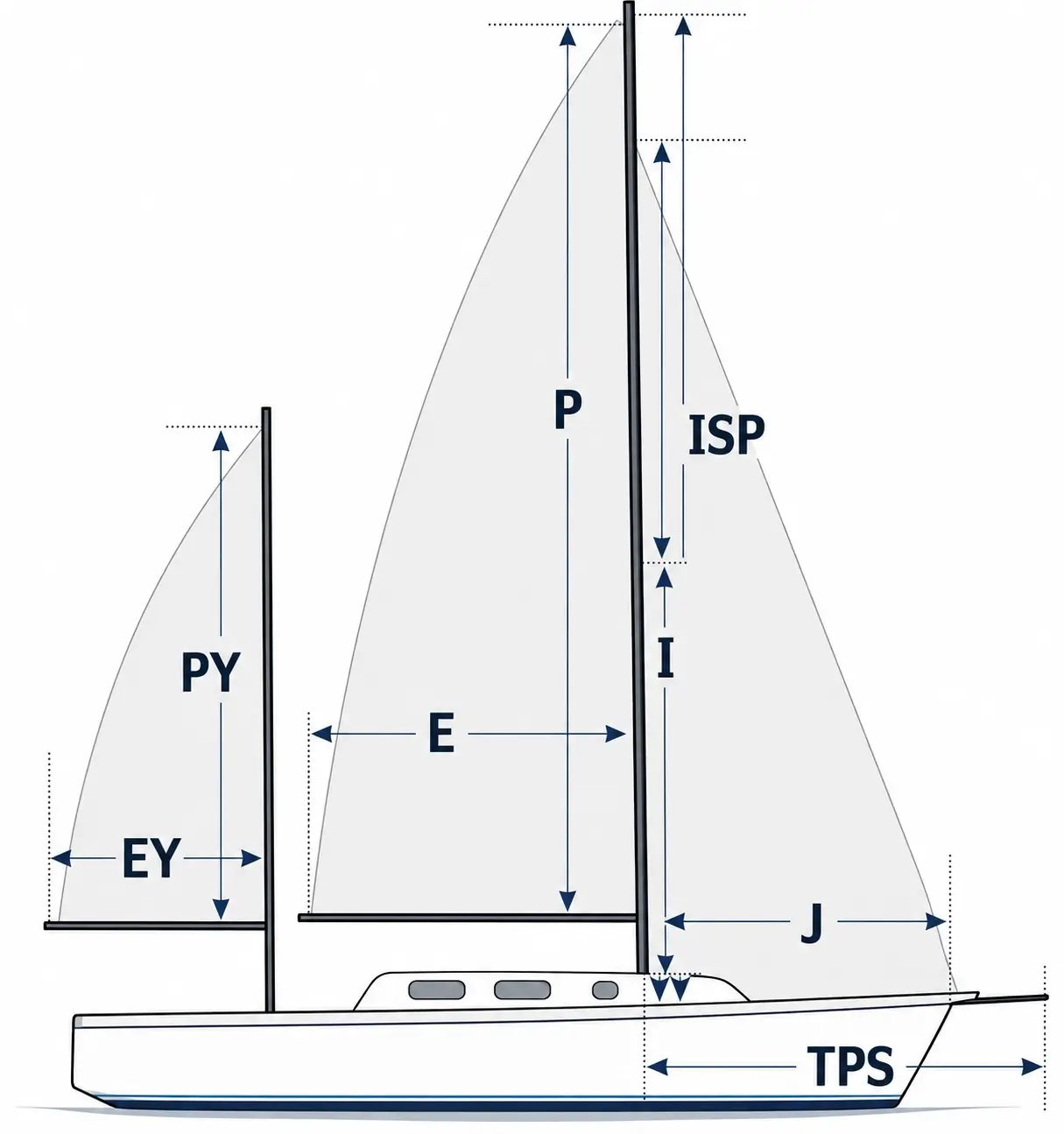
Standard foretriangle ($I$, $J$) and mainsail ($P$, $E$) measurement points.
Mainsail Area & Roach
The base calculation for a standard triangular mainsail is simple geometry using the luff ($P$) and the foot ($E$). However, modern sails are rarely perfectly straight. Sailmakers add a curved trailing edge (the "roach") to increase area and aerodynamic efficiency. To account for standard roach, rating rules apply a multiplier:
For Square-Top (fathead) sails, the sail becomes a trapezoid. We calculate the area by averaging the foot ($E$) and the Top Width, then multiplying by the luff ($P$), before adding any additional curve volume.
Headsail (Foretriangle) Geometry
Older rating rules simply calculated the foretriangle using the vertical height ($I$). However, to find the true physical surface area of the sailcloth, we must calculate the actual length of the forestay using the Pythagorean theorem, as the sail rides on the hypotenuse:
A 100% jib fits exactly into the foretriangle base ($J$). A 130% Genoa extends 30% further aft of the mast, increasing the LP and drastically increasing the total sail area.
Performance Benchmarks (SA/D & SA/L)
Total sail area alone doesn't tell you how fast a boat is. You must compare the area against the boat's displacement (weight) and waterline length.
> SA/D RATIO
The Sail Area to Displacement ratio compares power to weight. Because area is 2D and displacement is 3D (volume), we divide displacement by seawater density ($64 \text{ lbs/ft}^3$) and raise it to the 2/3 power to equalize the dimensions.
14 - 16: Heavy Cruisers
16 - 20: Moderate Cruisers
20 - 24: Performance Cruisers
24+: Racing Yachts
> WIND FORCE
Dynamic wind pressure increases exponentially with wind speed. This calculation estimates the total pounds of force pressing against your rig at a given wind speed ($V$), which helps determine reefing thresholds.